Provençal Homecoming
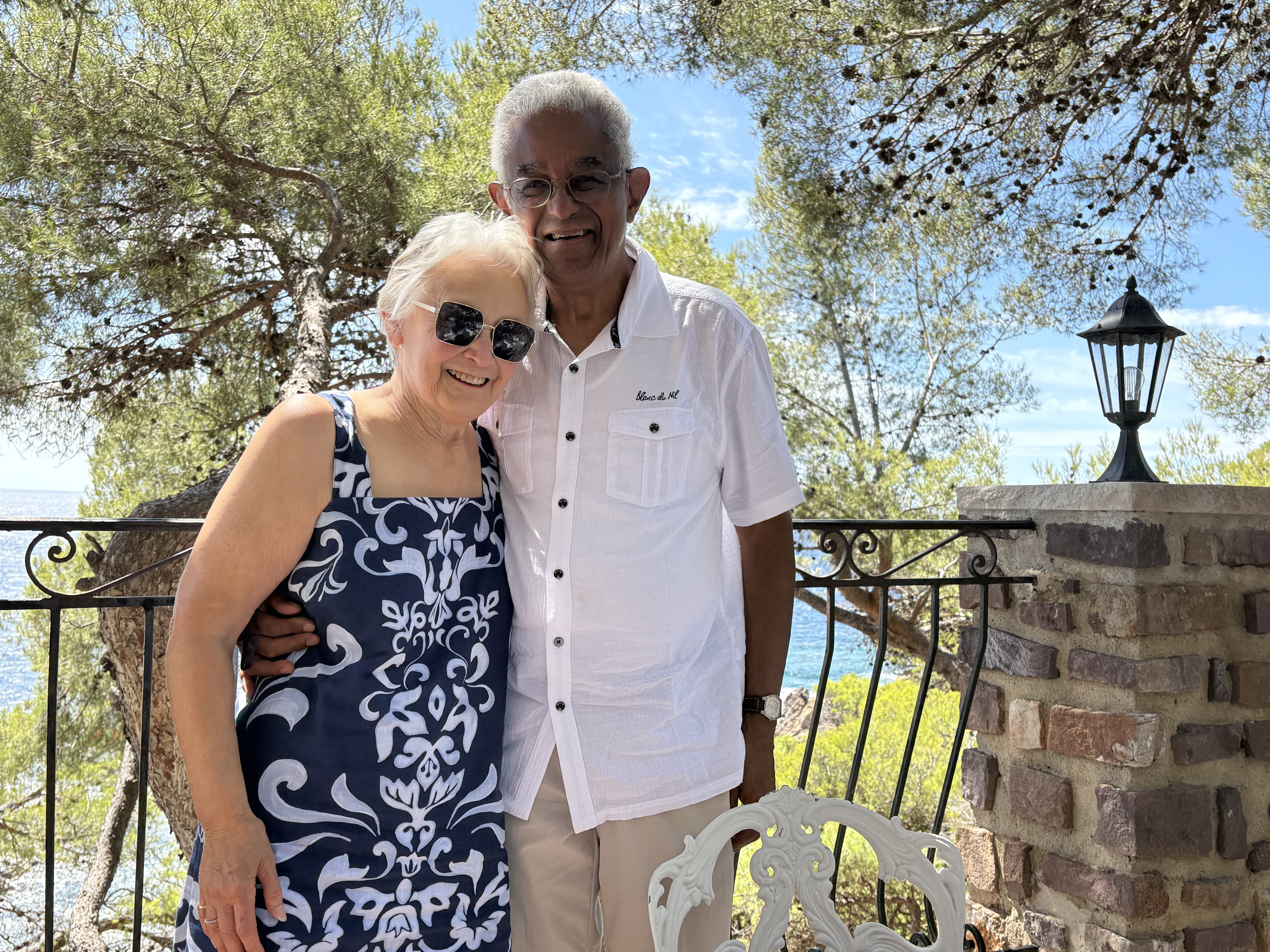
Here we are once again in southern France in our little adopted town, Le Pradet. It’s always a joy to be with our friends again – to enjoy the clear blue Mediterranean skies; to savor the aromatic coolness of French rosé; to relish the taste of the myriad cheeses; to eat a flaky croissant; to bite into a crusty baquette; to savor a mouth-watering fruit tart. We decided long ago that our trips to France would not be touristic; we would just blend into the local culture and follow the rhythms of daily life. When we go to the local open-air market, we are greeted by Mario who is always delighted to see us and from whom we weekly purchase our filet of cod (cabillaud in French). Until this trip, we were greeted as warmly by the cheese vendor. We learned that after the death of his wife a few months ago, he sold his business to a younger couple, Florian and his mother, whom we are getting to know.
At an earlier time in our marriage, Melanie and I fleetingly thought about buying a second home in France. We were visiting Melanie’s cousin and her husband in Britanny who often spent summer vacations in France in their caravan. At the time, they were living and working in England. One day, walking along the streets in Dinan, we glanced in the window of a real estate office and noticed a listing for an attractive apartment. The price was listed in francs. A couple of years later, after the adoption of European currency into euros, the price nearly doubled. Did we miss a good investment opportunity? Perhaps. But frankly, it would have been a stretch financially. Even though that opportunity slipped away, we still have now what we had dreamed about then – living in France. And, we didn’t have to buy. Since retirement in 2013, we’ve come almost annually to Le Pradet, a small town along the Mediterranean. In early 2000s, when I was vice chancellor of academic affairs at Indiana University South Bend (IUSB), I was instrumental in starting an exchange program of professors and students with the University of Toulon-Var. Because that exchange has lasted until now, we have many friends in southern France. We are fortunate to have a friend whose apartment attached to her home is available to us whenever we visit. Instead of living in Britanny we are living in Provence.
Our trip here this time was not without its misadventures. We arrived at night about four weeks ago by train to Marseille from Barcelona where we spent several days as a post extension to our Viking cruise on the Douro River in Portugal. (I’ll do a separate posting on that cruise later). When we arrived at the train station in Barcelona, we discovered that I had made the train reservation for September 6, instead of August 6. Luckily for us, with the help of a railway agent, we were able to purchase a new ticket even though the train was supposedly full. And we discovered, just before boarding that we had left one of our bags in the train station. Again, lucky for us, Melanie was able to retrieve it quickly before boarding. Our traveling missteps began anew upon arriving in Marseille. We stepped into the dark night once we left the train station. Our hotel for the evening was just down the street, yet somehow as we descended the stairs, we took a wrong turn. Disoriented, we were two hapless strangers hauling luggage roaming around the dark streets, an easy target for those seeking mischief. My phone GPS wasn’t helpful. Happily, a woman out for a late night stroll noticed two bewildered travelers and and pointed us in the right direction.
The next morning after a somewhat restless sleep, we walked to the Old Port to join a friend for lunch. And, you guessed it reader, in my search for La Canebière, a street leading to the Old Port, I once again took a wrong turn, and after wandering through several narrow city streets, we reached our destination. Once there, we happily stumbled upon our friend, Dolorès, who was patiently waiting for us. After a brief walk, we dined on seafood pasta and grilled fish at La Dorade, one of the many cafés along the streets that lead to the Old Port. After lunch, the three of us took a ferrry boat to the other side of the port where Dolorès delighted in pointing out the imposing architecture of City Hall and the surrounding buildings. We could easily have spent the rest of the day with this lovely, under five feet tall, eighty-four year old friend, but if were to reach Le Pradet before dark, we had to retrieve our rental car. We spent our first evening in Le Pradet with our friends, MariThé and Christian catching up over wine and cheese.
We spent our first couple of days lazily readjusting to life in Provence. We shopped for groceries at the supermarket , bought fruit and vegetables from the open-air market, strolled around the central plaza and park, settling into the rhythms of daily life. We always feel at home here. Delicious food and good wine define life in Provence as well as the sunshine and the occasional Mistral, the strong winds off the Mediterranean. We’ve had several meals with friends – lunch, dinner, an evening apéro, the latter an informal gathering of what we in the States would call heavy appetizers. One of the things we most enjoy here is taking short, and sometimes longer, road trips exploring the beauitful Provence countryside and quaint Medieval villages. There are myriad vineyards and orchards tucked among the hills and lovely little towns perched on steep rocky inclines. The roads are narrow with many hairpin turns. Though the panorama is beautiful, focusing on the road is critical, or we might find ourselves sliding down a gulley, or worse, a hillside. Barriers are practically non-existent along the isolated, rustic roads.
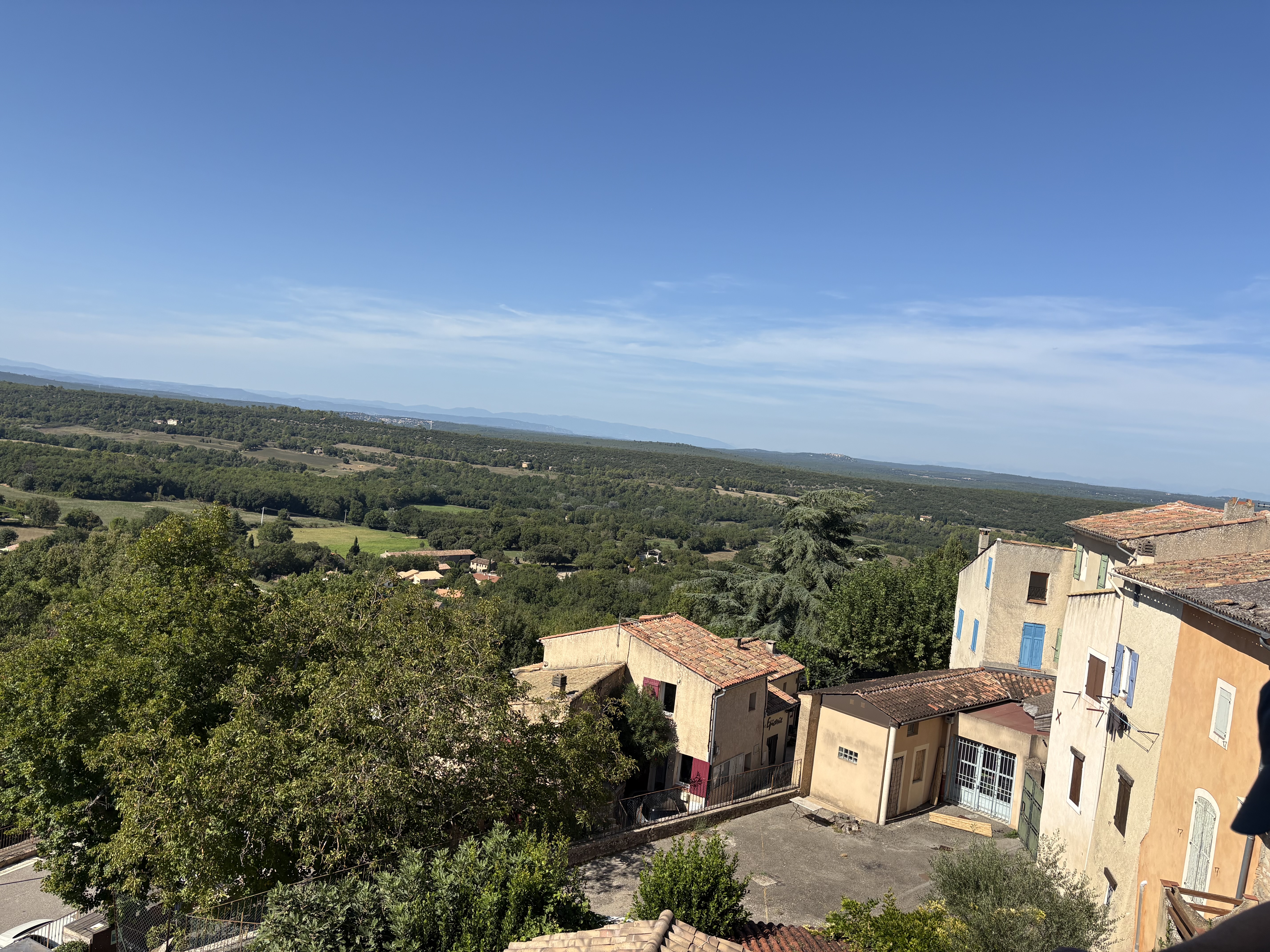
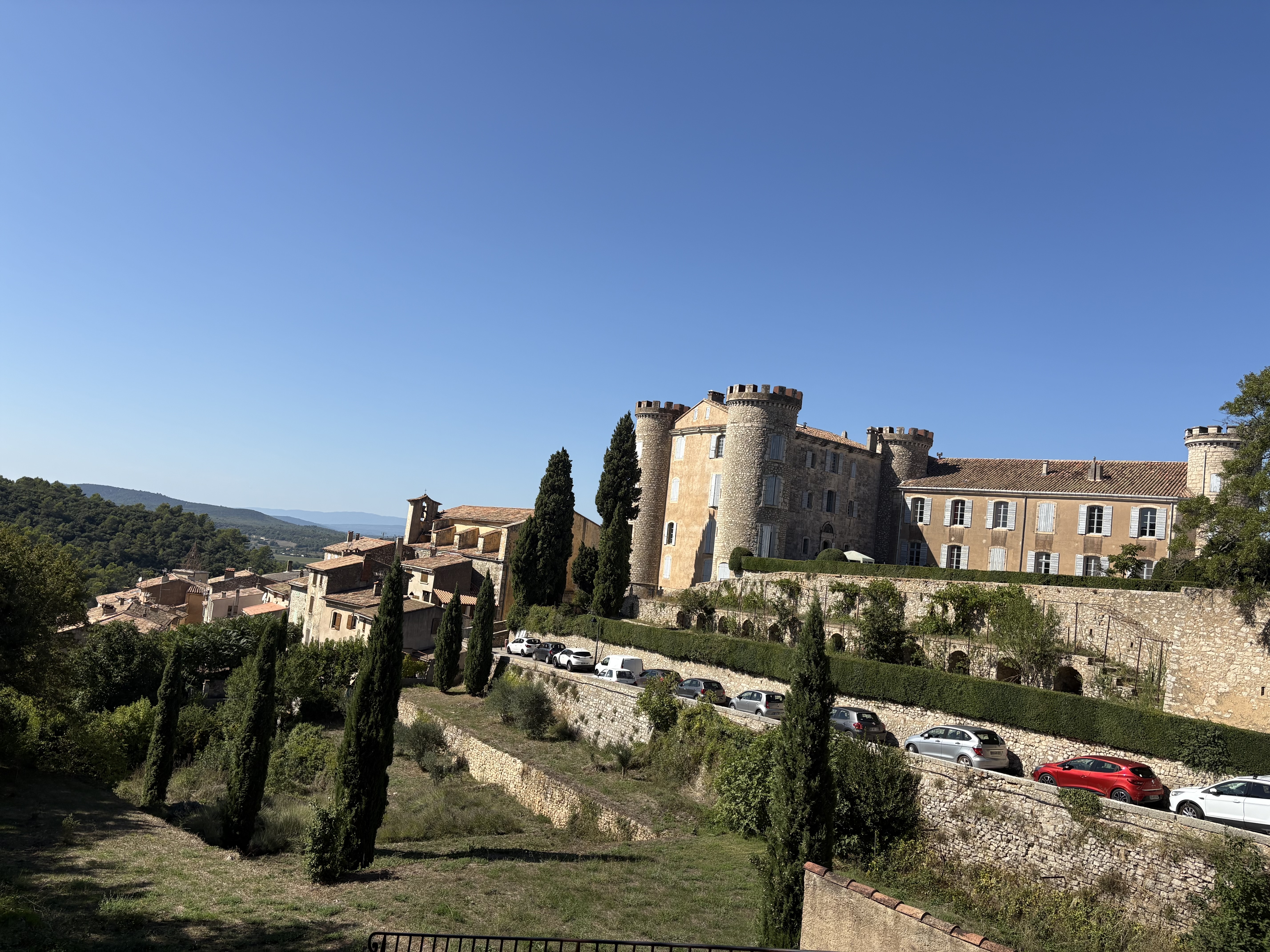
We spent a glorious day traveling those roads one day with friends, MariThé and Christian, and their friends Pascal and Soraya. Luckily for us, Christian was driving as the roads were steep and narrow, uphill and downhill, in endless twists and turns. We traveled deep into the countryside. Our destination was an ancient village, Saint-Martin-de-Pallières. Our friends were eager for us to visit the Medieval castle and underground cathedral there. To our dismay, we could not visit either. There was a wedding in the castle and the cathedral was locked. Instead, we walked around the narrow cobblestoned streets and enjoyed a picturesque view of the expansive valley below. From there we drove to Saint-Maximin-la-Sainte-Baume to visit the cathedral in whose crypt lie the remains of Mary Magdalene. We spent a few moments there in prayerful meditation. I lit a candle for a special intention. Before returning home, we sat in a café directly across the cathedral to enjoy a refreshing glass of wine.
Walking is an essential activity here. We’ve enjoyed strolls along the Old Port in Toulon, ambling along the city’s streets, casually soaking in the daily comings and goings. One afternoon, we stumbled upon a braderie (store sales). The streets in Toulon were lined with merchandise in front of stores. Crowds looking for bargains, elbow to elbow, moved slowly in waves. Clothing and other items were being sold for as little as five to fifteen euros. We were not tempted to buy except for a small colorful pottery dish. Other afternoons we’ve strolled to the beach, just a ten minute walk from our apartment. To get there we descend, then walk briefly up an incline and then walk down one hundred and two stairs, turn right, pass through a locked gate for which we have the key, turn left and walk a few yards to the beach. There we enjoy sitting along the rocky wall in the shade reading a book, people watching, walking in the sand, and occasionally, getting our feet wet in the cool water. We’ve yet to take a dip.
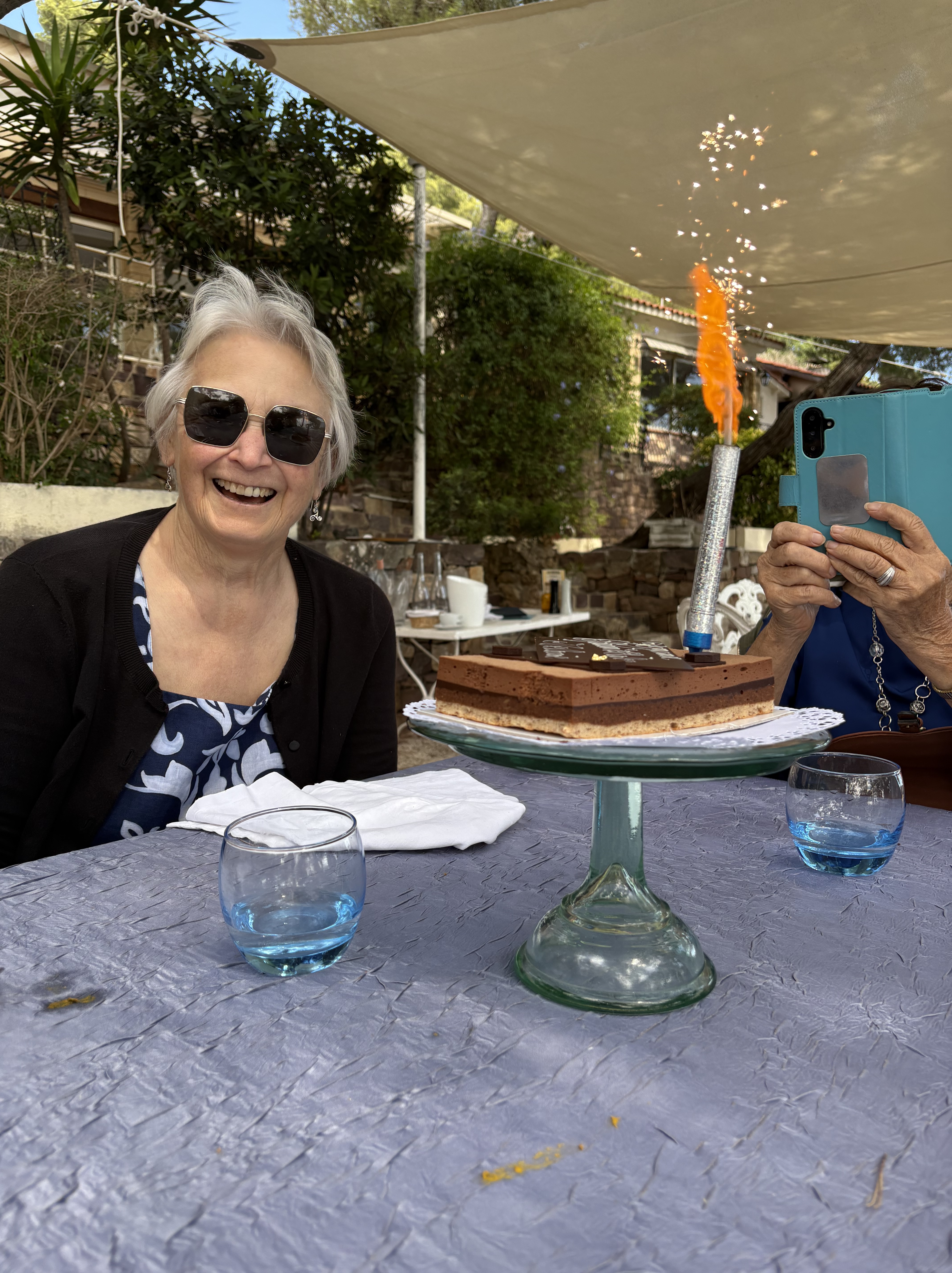
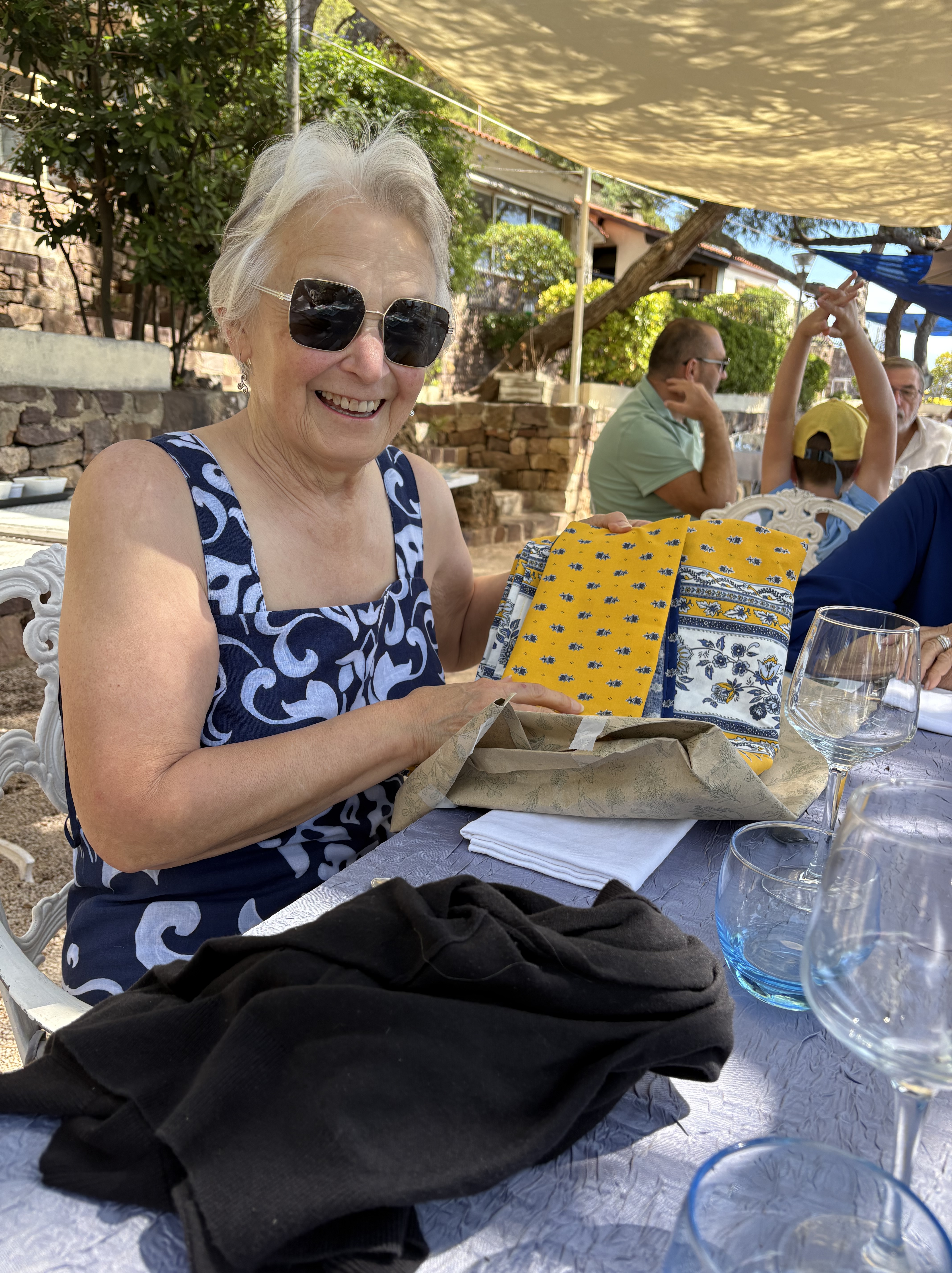
The most memorable moment of our visit in Provence was the day we celebrated Melanie’s eightieth birthday at a restaurant on the Mediterranean with several of our friends. She thought only she and I were going to a very nice restaurant. Imagine her surprise when she was greeted by friends already waiting for us at a table overlooking the Mediterranean. We dined that afternoon on bouillabaise and pasta with lobster. There was wine of course and a delciious chocolate cake for dessert. Our friends gifted Melanie with a beautiful Provençal tablecloth and napkins. Lunch began at 12:30 and we did not leave until well after four. It was indeed a joyous day.
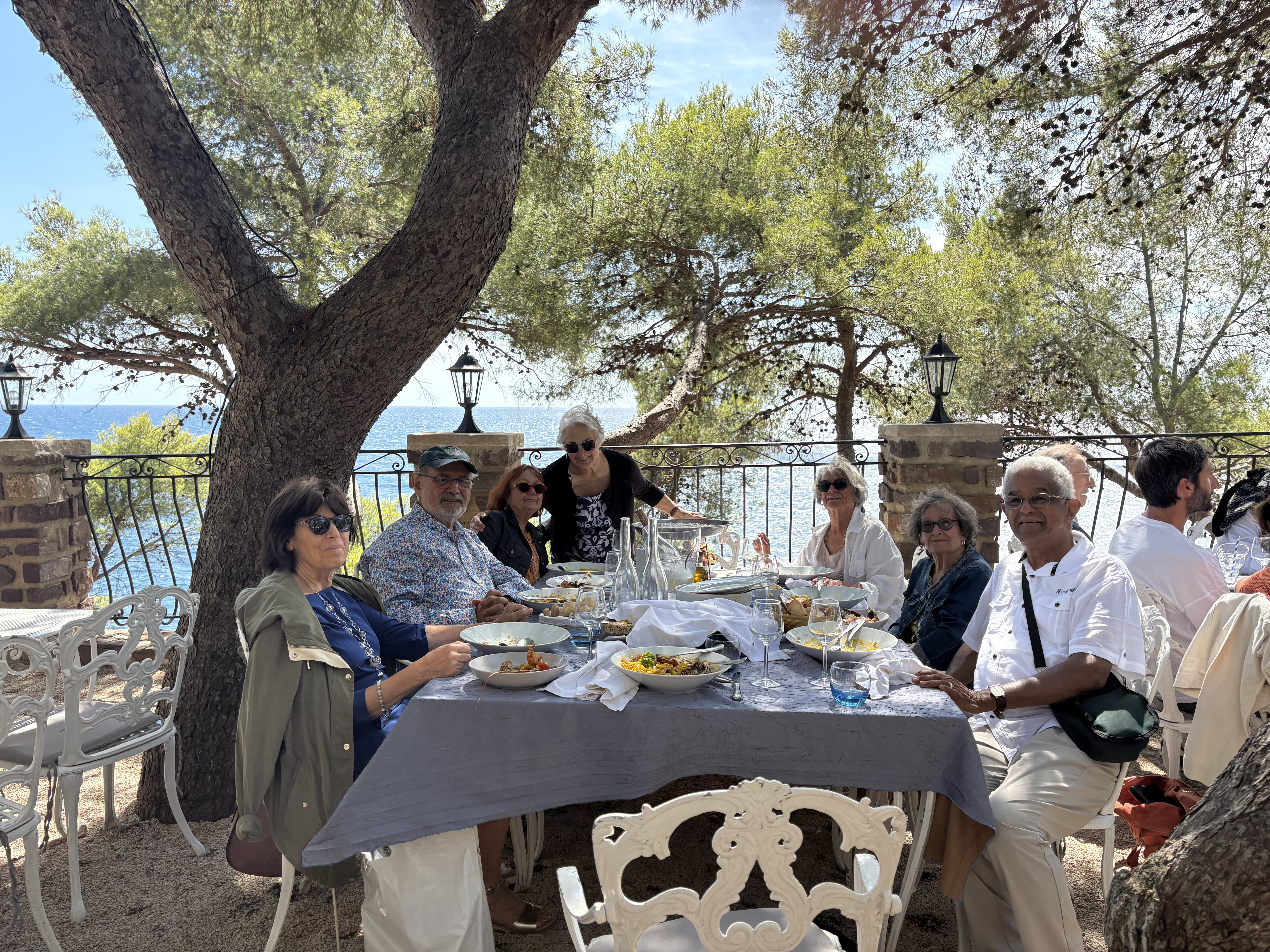
France is universally known as a gastronomical haven. The meals we’ve been eating at our friends’ homes have been delectably divine. One day our friend Danièle cooked an unforgettable meal of rabbit cooked in a delicious sauce with olives. The meal was paired with an equally fine white wine from 2003! We’ve never drunk a vintage wine! Jacques’ wine cellar has over two thousand five hundred bottles of wine. I mistakenly picked up a bottle and almost dropped it. That would have cost me several hundred dollars. I decided not to touch any more bottles. Just looking gave me a thrill. We spent the rest of the afternoon chatting over coffee and a raspberry tart.
On another afternoon we went on a gentle hike with Olivier and Valérie in an area called Provence verte (green Provence), more specifically the Vallon du Sourn. Walking among the lush greenery along a gently moving stream, the Argens, nestled among steep rocks stretching up to the clear marine blue skies was enchanting. Afterward we lunched in a small quaint town, Cotignac, that Melanie and I had visited just two days earlier. It’s astounding how cafés, with tiny kitchens, can prepare meals so beautifully presented. Here in France the presentation of a meal is as equally important as its taste.
A favorite pasttime for us here, besides visiting historic sites, is being part of the local cultural arts scene. We attended with MariThé, a two-woman lively play of various skits about their friendship over time. In the intervening moments between each kit, the women flipped over two large painted canvasses depicting the different landscapes at different times in their lives. It was an enjoyable comedy but sometimes we got lost in the rapidity of the dialogue. Thankfully, their gestures and movements across the stage enabled us to better appreciate the play. Before we leave, we’ll hopefully be able to buy the printed version.
One sunny afternoon, we took the ferry to the island of Porquerolles where we happened upon an exhibition of modern art at the Fondation Cormignac. Both Melanie and I, who are neophytes in appreciating modern art, found this exhibit fascinating. There was one work consisting of a large circle made up of shiny black orbs, which would slowly change color as you walked by.
One of our favorite movie theaters in Toulon is Le Royal, where foreign and French films are shown. One afternoon we saw an engaging Norwegian film, “Valeur Sentimental,” with French subtitles, about the dynamics and complexities of familial relationships.
And, needless to say, the architectural grandeur of churches and castles astonish even the most casual observer.

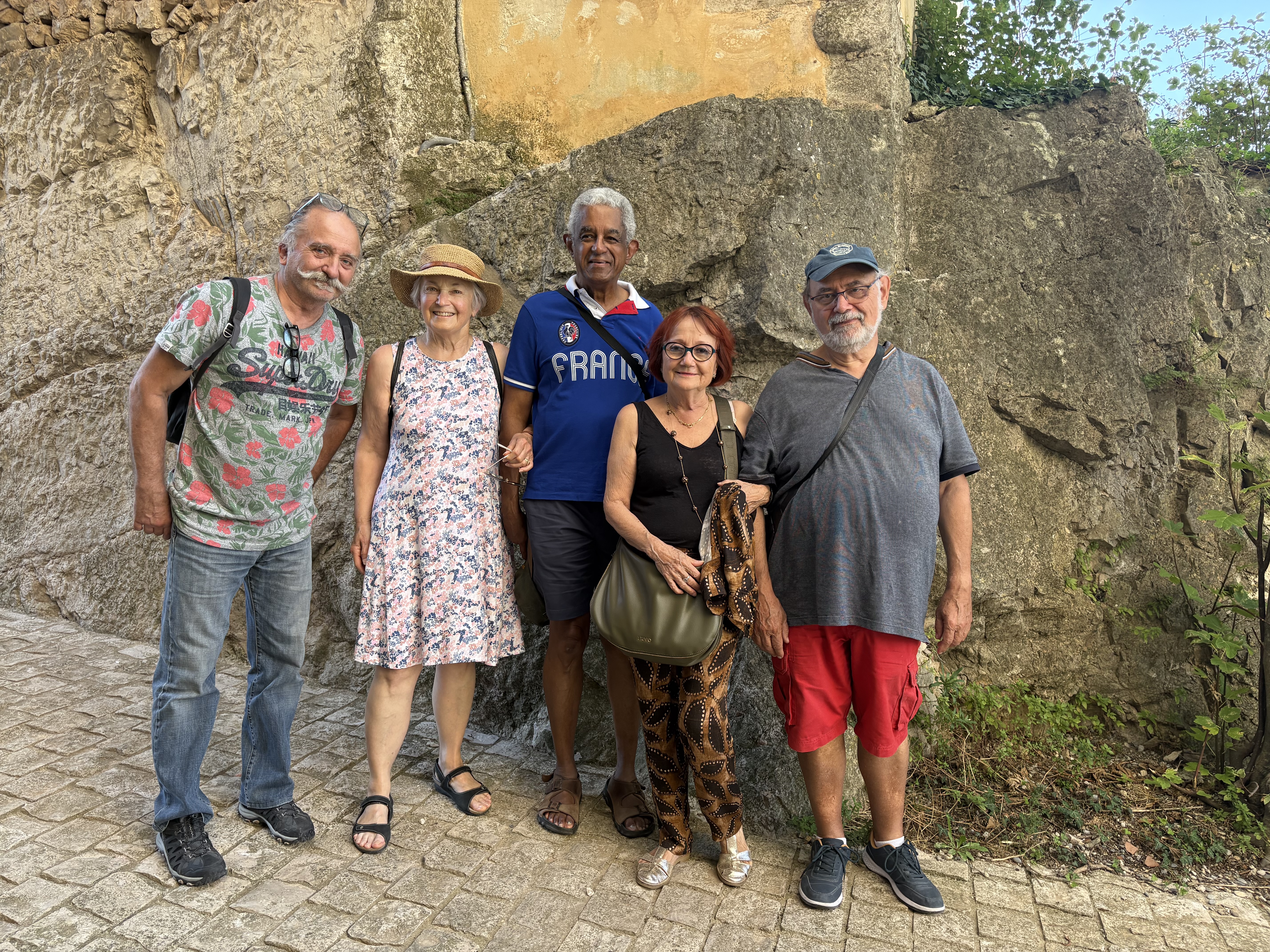
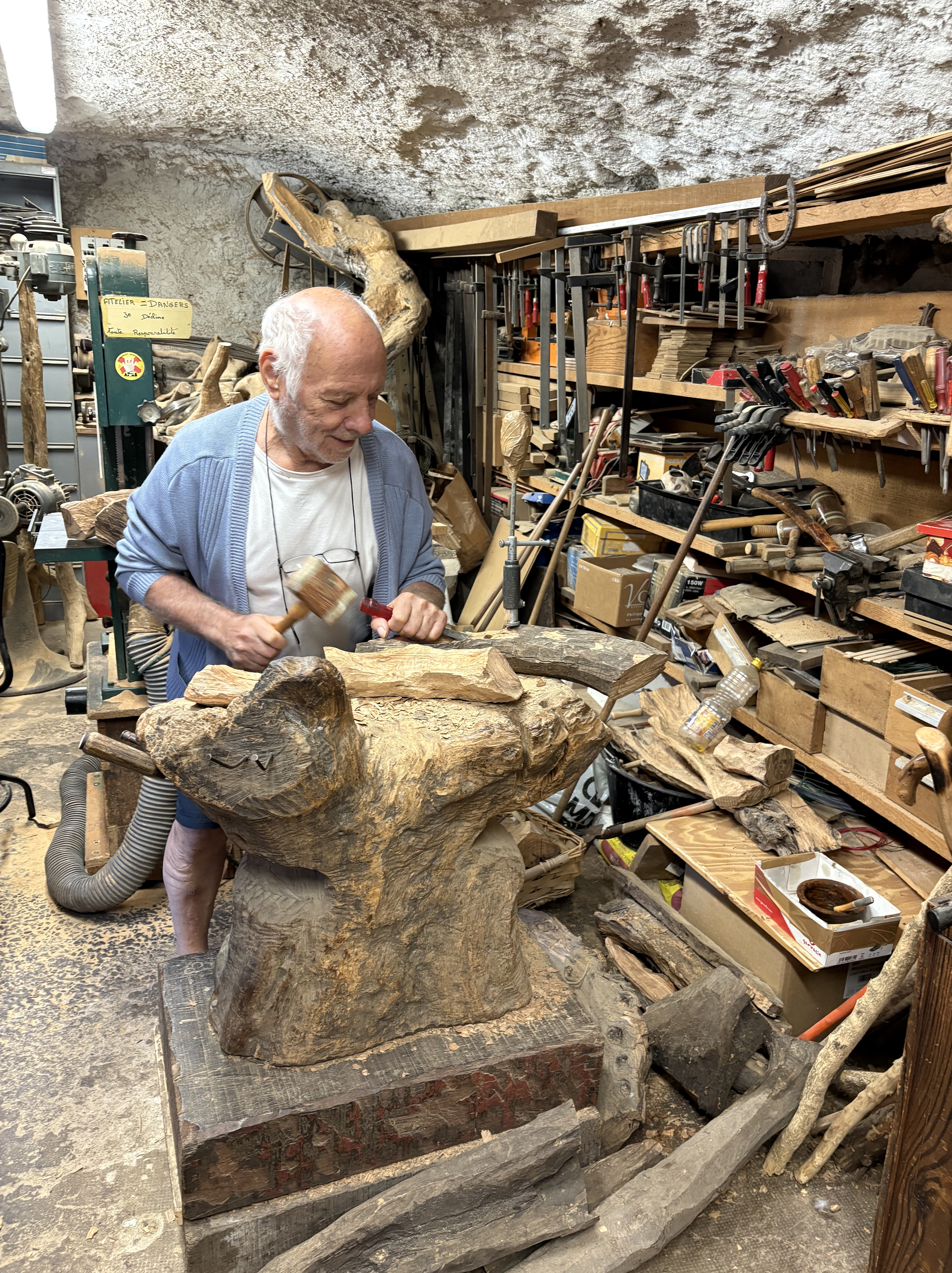
One morning Martine invited us to do a guided tour by the Office of Tourism of the old city of La Garde. As we climbed and turned into narrow cobblestoned streets, we had an inkling that we had walked these streets before. This time it was much more interesting as we learned about the town’s early development in the twelveth century. Perched on a hill, the town offered breathtakingly expansive views of the landscape below. For me, visiting the Roman chapel and the workshop of a wood craftsman at work were the highlights of the tour.
After the tour, we joined Martine at her home for a delicious fish soup accompanied, of course, with a bottle of rosé. Our time here is rapidly coming to a close, but before leaving there are other meals to share with friends. The invitations never seem to cease. But if the air controllers strike happens as planned on our scehduled day of departure, we may have a day or more in Provence.


Nerdy New Orleans

On our recent visit to the fair city of New Orleans, Melanie and I found this odd posting on a telephone pole “Black Nerd Festival.com.” It seemed an odd moniker for New Orleans. Although New Orleans has a rich literary history, think James Kennedy O’Toole, Percy Walker, Tennessee Williams, William Faulkner, Kate Chopin, Anne Rice, Frances Parkinson Keyes, Truman Capote, even Mark Twain, the more contemporary image of New Orleans is more hedonistic, think Mardi Gras and the Jazz and Heritage Festival where the good times roll. Even the annual New Orleans Book Festival, labeled as Mardi Gras for the Mind, can’t shake the image of New Orleans as the birthplace of jazz, a never-ending party town where bars never seem to close. After all, the city is famously known by a potpourri of nicknames: the Crescent City, the Big Easy, the City That Care Forgot, Gumbo City and Crawfish City. It’s the city of the Ain’ts until the NFL Saints won the 2009 Super Bowl. It’s hard then to imagine New Orleans as nerdy.
Curious to know more, I logged into the website. The festival appeared to be a celebration of black culture: music, dance, art, literature. Listed were a potpourri of panel discussions, oddly named as Warlords, Witches, Wizards and WhatNots. Topics ran the gamut of self-help to activism.
With each visit to my native city, I discover something new. It is arguably the most unique city in the Untied States with its blend of European, African, Caribbean and Indigenous cultures. It’s a tropical city with a European flavor, or for some, a European city with a tropical flavor. Either way, tourists and locals alike dance to syncopated jazz rhythms and savor its Creole and Cajun food. As the locals say “Love New Orleans and she’ll love you right back.”
What is most unique, and intriguing, about New Orleans is its manner of speech. It doesn’t take me long in the company of my family to slip into a New Orleans vernacular. Tourists say New Orleens. We natives say N’Awlins. And when we want to know how someone is feeling, we say, where you at? For us, lagniappe is a little something extra; the sidewalk is the banquette, derivative of our French culture. Not only do we love to party, we love to eat. Shrimp and oyster po’boys; crawfish étouffée, tomato farci, trout Amandine, andouille, jambalaya, mirliton, shrimp creole, and gumbo are all standard fare. We be happy and we be fine. In restaurants, service staff may greet you as Babe, Hon’, Sweetheart, Sugar, or in the regional Creole dialect, Cher, meaning Dear and pronounced Shaay! Rarely Sir or Madam. For me, these endearments reconnect me to my Southern Louisiana roots. “Yeah! Yo rite!”
This most recent visit to New Orleans combined a family trip with attendance at the annual convention of the 100 Black Men of America. I was one of the founding members in 2008 of a chapter in South Bend focusing primarily on mentoring young black males. “What they see is what they will be” is the slogan of chapters nationwide.
One of our signature programs is the school-based African American History Challenge. Throughout the academic year, students in the city’s high schools participate in an extracurricular activity studying African American history. At the end of March, the schools compete in a citywide championship for the privilege of competing at the national level for scholarships. For four years, our teams advanced to the second round; only this year did the team advance to the semi-final round, competing against sixteen other chapter teams from across the country. In today’s political climate where there are multiple assaults on intellectual inquiry and integrity, and attempts to whitewash, or alter, the uncomfortable truths in our nation’s treatment of Black Americans, it is imperative that today’s youth learn that the story of the making of America is not complete without knowing the history of Blacks in America. Through a guided study of African American history by a teacher in the high school with assistance from a mentor of the 100 Black Men of Greater South Bend, the students also learn about and take take pride in the extrordinary accomplisments of Blacks in the fabric of American life.
When I retired from Indiana University South Bend, many assumed that I would return to that lovely city on the bayou. I love my native city; I am seduced by its charms, its easy way of living; its dichotomous connection to sin and saintliness. Though I have this love affair with the city, I have planted roots elsewhere. As Louis Armstrong nostalgically sings, “Do you miss New Orleans, and do you miss it each night and day.” Sure I do. For those who know me well, who I am is inextricably tied to New Orleans. But home now is South Bend. That’s where I want to be. Through my activism and volunteering, I’m helping to shape South Bend’s future.
A Beautiful Day
Now is the time for all good men and women to come to their senses. Amidst, the chaos, let us remember that we have agency. Gandhi reminds us to be the change we want to see in the world. Take action, get invovlved, do random acts of kindness.
When I was a kid, our parish held a weekly Tuesday evening novena to Our Lady of Perpetual Help. It was one of the many routine rituals of my Catholic upbriniging in New Orleans. I have vivid memories of the quiet, dimly lit sanctuary — the faithtful gathered for devotional prayers, some on their knees fingering the rosary, others seated in meditative prayer, some genuflecting and crosssing themselves before entering a row of wooden pews – everyone seemingly enveloped in an invisible cloak of tranquility. I still picture that simple cream-colored stucco church, the soft glow of the glimmering candles, the sweet smell of incence. I hear still the organ’s deep harmonic vibrato as the devotees sing in pious unison.
I recall those days with nostalgia — when as a youngster the world seemed gentler even if it weren’t. For me, they are a stark contrast to today’s turbulence and anxiety. So amidst the noise of politics, I reclaim my space and declare that today is a beautiful day. Those lingering memories of Tuesday evenings in a quaint little church are a balm to the pain I feel of a fading “America the Beautiful”. More and more I need those moments of solace, to reconect with my inner self, but more important, to revalidate the humanity I share with my fellow human beings in Gaza, in Ukraine, in the Sudan, in Syria, in Latin America, and all across the globe where human dignity is a target. Sadly, the same is true in this country, where currently the ideals of truth, liberty and happiness are under attack. Do not the lessons of the Sermon on the Mount apply anymore?
The answer lies in the wisdom and courage of other voices as alternatives to the divisive political rhetoric that daily bombards the airways:
True peace is not merely the absence of tension; it is the presence of justice – Martin Luther King, Jr.
Freeing yourself was one thing, claiming ownership of that freed self was another -Toni Morrison
You submit to tyranny when you renounce the difference between what you want to hear and what is actually the case – Timothy Synder
I imagine one of the reasons people cling to their hates so stubbornly is because they sense, once hate is gone, they will be forced to deal with pain – James Baldwin
The true measure of any society can be found in how it treats its most vulnerable members – Mahatma Gandhi
Not all of us can do great things. But we can do small things with great love – Mother Teresa
Choose to be in touch with what is wonderful, and healing within yourself and around you – Thich Nhat Hanh
We must do what they fear — tell the truth. This is the most powerful weapon against this regime of liars, thieves and hypocrites. Everyone has this weapon. So make use of it – Alexei Navalny
They who give up essential liberty to obtain a little temporary safety deserve neither liberty nor safety – Benjamin Franklin
And my response is, I choose freedom over tyranny, optimism over dread, love over hate, action over lethargy, resistance over silent complicitiy.
Baldwin’s America Today: Hope or Despair?

Baldwin’s America Today: Hope or Despair?
First Unitarian Universalist Church, South Bend, IN, May 16, 2021
Alfred J. Guillaume, Jr., Ph.D.
Good morning friends. When Florence first asked me to do this sermon on James Baldwin, I was both honored and surprised. I had already had a lively Baldwin discussion with several of you about Baldwin’s masterful essay, The Fire Next Time, as part of the UU Auction. And although, I’ve spent the last year reading Baldwin in preparation for a one-credit hour graduate seminar that I taught this spring, I struggled deciding on an appropriate title for today’s service. As I reflected on current events, I began thinking about what Baldwin would say about his America today. It is without question Baldwin’s lasting impact on the literary canon, but is his writing still relevant? If so, what can we learn in our nation’s continuing struggles to achieve racial, social and economic justice?
Unlike many of his contemporaries who risked bodily harm by putting themselves physically in the battle for social justice, Baldwin used the power of the pen and the force of his writing to awaken the unconscious to the evils of racism. For those among his fellow Americans, fully aware of injustice, his searing words pricked their consciousness from lethargy to active movement in the cause of justice and equality. As Rev. Dr. Martin Luther King so eloquently expressed in his Letter from Birmingham Jail to his fellow clergymen who wanted him to “wait,” “…justice delayed is justice denied.” And unlike Stokely Carmichael, Baldwin did not spend tiring hours and days in the sweltering heat of Alabama and Mississippi in Negro voter registration efforts that often proved naught. Nor did he spout the angry rhetoric of Malcom X in urging change either through the “Ballot or the Bullet.” And he did not risk his life as a Freedom Rider as did John Lewis and countless others, black and white, and from every faith. No, Baldwin pierced the consciousness and soul of America through the eloquence of his pen. He was brutally honest, yet gracious and caring. No matter how much rage he carried within him, he remained an apostle of love. No matter how harshly America treated the Negro, no matter how painful the sting of hatred toward the Negro, he remained resolute in dignity.
Baldwin grew up in poverty in a world far removed from mainstream America. He learned at an early age the horrors of being considered less than the other, white Americans. His part of town, Harlem, was left to fester in crime, drugs and pimps and prostitutes. Bars and churches proliferated. Both shields from an unkind and uncaring world. Like his stepfather, with whom he had a difficult relationship, he sought refuge in the church as a preacher. At the age of thirteen, Baldwin was renowned as an eloquent preacher, gifted by the Holy Spirit. But unlike his father, he was not torn between Christian love and hatred for and fear of white people. Baldwin had white friends in school and a white teacher, to whom he was forever devoted, who nurtured his brilliance by taking him to movies, to the theaters and to concerts.
Baldwin eventually left the church, but the church never left him—the evidence is deeply interwoven in his writing style–quick bold statements, punctuated in a staccato rhythmic call and response. Baldwin also left America. Like so many artists, writers and musicians before him who sought refuge from the oppressive walls of racism and deep-rooted feelings of being unwanted and isolated in America, he exiled himself in France. He left America to be himself. Had he remained, he felt he could not be free to become a writer, and as a Negro he was not allowed to participate fully in the grand experiment of democracy. In Notes of a Native Son, he remarks: “The American Commonwealth chooses to overlook what Negroes are never able to forget: they are not really considered a part of it.” He faced this rejection in a New Jersey restaurant by a waitress who reminded him that Negroes were not welcomed there. Angered and hurt, he threw a glass of water in her face. He fled in fear, fully aware of the unspeakable retribution that he faced as a black man for this dastardly deed. Baldwin recalls this experience in Notes of a Native Son: “I lived it over and over again, the way one relives an automobile accident after it has happened and one finds oneself alone and safe. I could not get over two facts, both equally difficult for the imagination to grasp, and one was that I could have been murdered. But the other was that I was ready to commit murder. I saw nothing very clearly but I did see this: that my life, my real life, was in danger, and not from anything other people might do but from the hatred I carried in my own heart.” And it is precisely that hatred that Baldwin refuses to harbor in his heart. And that is why, after several years in exile, he felt compelled to return to America to participate in the Civil Rights Movement, particularly when on the front pages of the American and French newspapers he saw the images of Dorothy Counts being jeered and spat upon by angry crowds of whites as she entered what was previously an all-white school.
Through his pen, Baldwin became the voice of the Civil Rights Movement. He issued the clarion call for justice. Through his popularity as a writer, he gained access to Hollywood and raised monies to support the Movement. He courted the rich, the famous and those with influence and power. Marlon Brando became a personal friend. Robert Kennedy invited him to his office. He was at the center among other prominent dignitaries at the 1963 March on Washington but was denied a turn at the podium for fear that his homosexuality would be a distraction. Nevertheless, his most enduring contribution to the cause of freedom and justice was, and still is, the clarity and precision of his words that pierced the consciousness of a nation. He told brutal truths about America. He castigated America for its failure to fulfill its promise of justice and equality for all. He chided white America for clinging to a myth of greatness, for its belief in the supremacy of whiteness, for its behemoth lie about itself. Baldwin’s writing is a searing indictment of America. In the heartwarming letter to his nephew in (My Dungeon Shook)The Fire Next Time, he reminds him that.. “(T)his country set you down in a ghetto in which, in fact, it intended that you should perish. Let me spell it out precisely what I mean by that, for the heart of the matter is here, and the root cause of my dispute with my country. You were born where you were born and faced the future that you faced because you were black and for no other reason. The limits of your ambition were, thus, expected to be set forever. You were born into a society which spelled out with brutal clarity, and in as many ways possible, that you were a worthless human being. You were not expected to aspire to excellence: you were expected to make peace with mediocrity.”
In his essay, “The White Man’s Guilt,” Baldwin’s concludes that white America’s biggest failure is to accept their “appallingly oppressive and bloody history,” a history “which menaces, and for which they bear an inescapable responsibility. But since in the main, they seem to lack the energy to change this condition, they would rather not be reminded of it.” But he goes on to say that Americans “are impaled on their history like a butterfly on a pin and become incapable of seeing or changing themselves, or the world.” Baldwin bemoans that whites have fed themselves a lie (a lie about what America is) and do not know how to release themselves from it. Further along in the essay, Baldwin opines in a reference to the Iron Curtain: “The American curtain is color. Color… One can measure very neatly the white American’s distance from his conscience—from himself—by observing the distance between White America and Black America. One has only to ask oneself who established this distance. Who is this distance designed to protect, and from what is this difference designed to offer protection?”
So that was Baldwin’s America? What is ours today? Let’s examine it. I dare say that the myths about America persist. We refuse to acknowledge the bloody history of genocide of our nation’s indigenous people; we gloss over the brutality of 400 years of slavery; Mitch McConnell and his ilk do not want the history of the 1619 Project taught in our schools; we prefer to focus on the land of freedom and justice for all, ignoring that many of our forefathers owned slaves and that the promises of the Constitution discounted blacks, and limited the freedoms of women; we want to forget Jim Crow, lynching and forced subjugation of blacks; we honor MLK, yet systemic and institutional racism is pervasive; our economic systems continue to prey on and exploit blacks; we actively push sub-prime loans with high interest, we redline neighborhoods, businesses routinely abandon minority communities; educational parity is non-existent; vouchers and inequities in taxation decimate inner-city schools; we incarcerate black men disproportionally to their population; black males are three times as likely to encounter death by a police officer; inequities in healthcare decrease the lifespan of blacks.
What then would Baldwin say about America today? Surely, he would be disappointed. He would feel betrayed by legislation in many states at voter suppression. He would be appalled by the Big Lie that is polarizing our country politically; he would use the power of his pen to malign efforts to diminish the sanctity of our democratic principles. He would decry those who stoke the flames of racial, and ethnic hatred. In his essay, “Many Thousands Gone,” he reminds us: “The story of the Negro in America is the story of America—or more precisely, it is the story of Americans.” In his essay “Everybody’s Protest Novel: “It must be remembered that the oppressed and the oppressor are bound together within the same society….” Baldwin’s rage about the injustices of his time was real. He fought against racism. He rejected the characterization of blacks by whites. He refused to think of himself as less than human. His anger was tempered by knowing that he shared a common humanity with whites. He understood that whites in their willful victimization of Negroes, were victimizing themselves. And in his encounter with Elijah Muhammed that he so beautifully described in The Fire Next Time, he rejects Elijah’s description of whites as devils, saying to himself, but not to Elijah: “I love a few people and they love me and some of them are white, and isn’t love more important than color?”
Until his death in 1987, Baldwin remained a provocateur, pushing America to accept its past and thus free itself toward racial healing. He wanted America to be what it can be. To co-opt the title of an article that recently appeared in the Atlantic Monthly, Baldwin was right all along. He exposed this country for what it is. In his famed debate with William Buckley at Oxford in 1965, he said, “It comes as a great shock to discover the country which is your birthplace and to which you owe your life and your identity has not, in its whole system of reality, evolved any place for you.” On the last day of my graduate seminar, I posed these questions to my students, and I now pose them to you. What has Baldwin taught us? What have we learned? What is he asking us to do to make America what it says it is? How do we help America fulfill its promise of liberty and justice for all? Ultimately, Baldwin is asking white American to admit its historical complicity in the systemic and institutional racism that continues to plague this country. Unless that is done through honest and sincere self-examination, there is no path forward. He asks black Americans, though justified in their anger, not to despair, not to hate white Americans, but to join in fellowship with those of goodwill in the fight for justice. Baldwin did not yield to defeatism; he did not abandon America. Nor should we.
I close with Baldwin’s admonishing words to his nephew in The Fire Next Time:
“If we—and now I mean the relatively conscious whites and the relatively conscious blacks, who must like lovers, insist on, or create, the consciousness of the others—do not falter in our duty now, we may be able, handful that we are, to end the racial nightmare, and achieve our country, and change the history of the world. If we do not now dare everything, the fulfillment of that prophecy, re-created from the Bible in song by a slave upon us: God gave Noah the rainbow sign, No more water; the fire next time!”
Summary statements at end of the service:
American Dream and American Negro
“Unless we can establish some kind of dialogue between those who enjoy the American dream and those people who have not achieved it, we will be in terrible trouble. This is what concerns me most.”
We Can Change the Country
“We have already paid a tremendous price for what we have done to the Negro people. We have denied, and we are paying for the denial of the energy of twenty million people. No society can sustain that. The future is going to be worse than the past if we do not let the people who represent us know that this is our country. A government and a nation are synonymous. We can change the government and we will.”
Summer Journeys Past and Imagined
Ordinarily, Melanie and I would be ending our weeks-long stay in Paris after a glorious Baltic Sea cruise with friends, Pam and Don Wycliff. Covid-19 curtailed all that. Instead of visiting the beautiful cities of Oslo, Bergen, Copenhagen, Berlin, Gdansk, Tallinn, St.Petersburg, Helsinski and Stockholm, we were moored, so to speak, in Granger, Indiana, sheltered-in-place. For weeks now, we have not ventured far from home. We’ve escaped for a brief car ride to see the flowering spring trees and the rose-colored leaves of the Redbud Trail. Our groceries are done online; we pick up our prescriptions at the pharmacy drive-through; we attend church services on Zoom. We now travel virtually. We have Zoom visits with the grandkids in D.C. and Portland and with our children in Boston and Las Vegas. Zoom travels also include New Orleans, Cape Cod, Madison, Duluth, Taos. In this new normal of our lives, we socialize with friends and family for virtual cocktails, conversation, dinners and Codenames-a spy game.
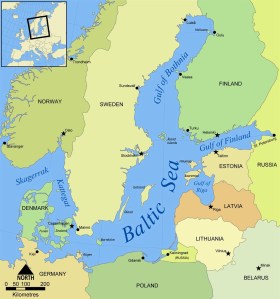 Our now aborted cruise was to be a grand celebration of Pam and Don’s tenth wedding anniversary. For me, the travel to the Scandinavian countries and to St. Petersburg was at the top of my happiness file, a preferable term to bucket list which has an ominous finality to it. At the conclusion of the cruise, Melanie and I were going to spend several weeks in Northern France and, time permitting, a quick jaunt to southern France to see our friends there. Both Melanie and I have long wanted to visit the Normandy beaches. We had hoped to visit our dear friends, the Lallement family, who produce champagne in Verzenay. We hope to cruise the Baltic next spring, but that will depend on the worldwide status of the pandemic and the availability of a vaccine. Until then, I continue to dream of voyages that might have been.
But I can write about our travels of last summer and fall. When I first began to think of writing about those journeys, the trees were a vibrant, lush green, the air warm and humid. Since then the orchestral beauty of autumnal leaves have faded. The winter snows have melted, and the blossoming buds of spring have given way to a new abundance of lush green canopies. And only now in mid-summer I write about the summer past.
As a youngster, I enjoyed watching the Dinah Shore Chevy Show. At the end of each episode, Dinah, in expressive voice, sang this musical refrain, “See the USA in your Chevrolet.” Since retirement seven years ago, Melanie and I have been doing exactly that, but not in a Chevrolet. Our travels of late have been either in a Toyota or Honda. And we’ve become fond of train travel, which at our age we find relaxing. In summer 2019, we boarded trains, sometimes round trip, other times one-way, to Portland, Oregon, Boston and the nation’s capital. I flew from Las Vegas to Maine to join Melanie and our friends Faith and Skip, who had just celebrated their fiftieth wedding anniversary, and with whom we spent several days at their lake cabin.
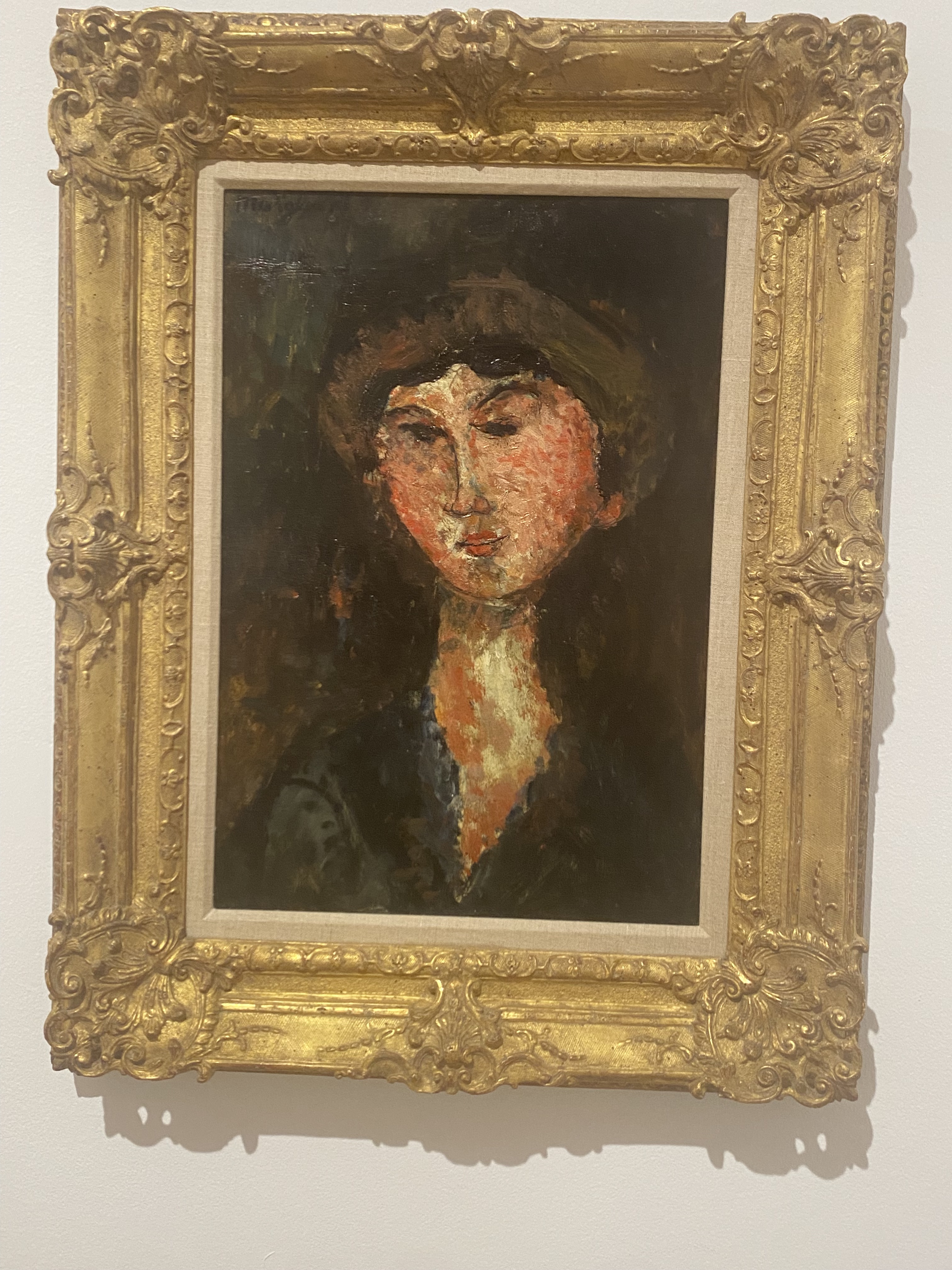
One glorious afternoon we all took a ride through the Maine countryside and stopped at a Revolutionary-era graveyard. The gravestone etchings, weathered over the last two hundred and fifty years, were almost impossible to read. Upon our return to the lake cabin, we discovered a tick on Melanie’s leg. Fortunately, we were able to dislodge it. And happily, Melanie had no lingering after effects of lime disease. Another surprise of our Maine visit was reuniting with my former next door neighbors in St. Louis, Bob and Marge Moskowitz, whom I’ve not seen in over twenty plus years. By happenstance, we learned of our proximity to each other through Facebook. Both are artists who live and teach in southern California, but paint in Maine at their summer home studio. For my fiftieth birthday, Bob came to California to do a portrait of me and my two sons. That painting hangs today in our living room.
From Maine, we motored to Boston to visit Amanda, Melanie’s daughter. On a day trip to New Bedford, we visited the whaling museum which opened up another imaginary voyage for me. Having grown up in southern Louisiana, the whaling communities along New England’s coast were foreign to me. It was not until I was a graduate student at Brown that I first encountered the ethnic Azoreans and Cape Verdeans who dominated the whaling industry. The museum catapulted me into a fascinating world of whaling. We spent about two hours there and I could have easily doubled that time meandering among the instructive exhibits. Hanging in the interior atrium of the museum were several skeletons of whales. They reminded me of the biblical story of Jonah and the whale and of the Disney story of Pinnochio and his father, Gepetto, who was swallowed by the whale. To me, each of these parallel allegories is a story of distress and survival.
On board a replica of a whaling vessel, I was astonished that at 5’10,” which is not very tall, I had to lower my head. The ships were built obviously for men shorter than I, but most assuredly, given the roughness of sea living and the hard work of whaling, they were much stouter and stronger. This suspicion was validated by the photographs in the exhibit, and equally confirmed by the images of Paul Cuffee, a prominent merchant, seaman, and whaler of black and Indian parentage. Cuffee served as a privateer during the American Revolution. I vaguely remember reading about him in my early schooling. A Quaker, he was a strong opponent of slavery and, like Frederick Douglass, a fierce abolitionist. Throughout the museum, there were dizzying exhibits of historic whaling instruments and period furniture. Intriguing were the permanent collections of lithographs, watercolors and whaling etchings. There were paintings by Dutch and Flemish masters, Chinese artists, including illustrative drawings by a native son, George Gale, depicting daily life in the whaling community. Gale’s sketches were remarkably detailed, almost lifelike.
I remember New Bedford during my graduate school days at Brown as a town of garment factories. It was there, in the warehouse district, where I bought my winter coat and where I took new graduate students from warm climes to buy their cold weather clothing. These same warehouses have been converted to halls of antique shops. Aficionados of whatever ilk roam the aisles in search of discarded treasures. My roving eyes lighted on a 1950s Sheaffer fountain pen and pencil set, which I happily purchased. They, with the quill and glass pens that I also bought, now reside among my collection of fountain pens.
Before leaving the museum, Melanie, Amanda, and I visited the gift shop. There, among the stacks of books were Herman Melville’s Moby Dick and a new Putlizer prize biography of Frederick Douglass by David W. Blight. I had only read excerpts of Herman Melville’s masterpiece in high school, and in college, Douglass’ autobiography. Melanie read not long ago a graphic novel about his life which she thoroughly enjoyed. I committed myself to read Blight’s biography and Moby Dick.
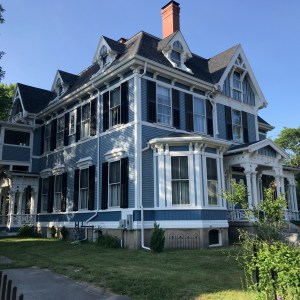 Upon our departure from the museum, we walked leisurely through town admiring stately, architecturally appealing houses. Gazing bewilderingly from one dwelling to another, I fancied walking throughout these houses, admiring the furnishings, speaking to those, who over the decades called these places home. Each home had its unique character. I studied carefully each home’s landscaped garden, judging amusingly whether it complemented or detracted from the home’s attractiveness.
Another day, the three of us visited the JFK library, an imposing structure along the bay. Disappointingly, the museum seemed barren of furnishings, exhibits and artifacts due, no doubt, to the relatively short tenure of Kennedy’s presidency. Among the exhibits were numerous pictures — President Kennedy and John-John in the oval office, he and his family sailing or playing touch football at Hyannis Port, the presidential couple. Most striking was that iconic picture of him and his brother, the attorney general , their heads bowed contemplating the enormity of the Cuban Missile Crisis, their dark profiles set against the bright light filtering into the room. The starkest and most startling exhibit was that of Mrs. Kennedy’s pink blood stained suit. I remember in vivid detail the day President Kennedy was shot. I was a senior in high school. My classmates and I were in the school yard during our daily calisthenics when over the loudspeaker Father Grant, the principal, announced in a subdued voice that the president had been shot and killed. We all stood still, shocked and in disbelief. Led by Father Grant, my classmates and I, many of us in tears, recited the Our Father. I still feel the chills of that moment.
In late summer, on a hot, sometimes rainy day, my friend, Bob Kill, and I took a day-long trip to his hometown of Delphos in western rural Ohio along Route 66. While this is not the famed Route 66 that Nat King Cole crooned about, it still holds many fond memories for Bob of his teenage and early adult years. Before reaching Delphos, we cruised through Archbold and passed in front of the house that Pat and Bob lived in during the early days of their sixty-one year marriage. When we reached the small town of Delphos, we stopped to pick up his sister Cindy, who now lives in the family home. While there, I leafed through a scrapbook of yellowed newspaper clippings of Bob as a high school basketball phenom. Shortly thereafter, we picked up the ninety-three year old widow of his high school hoops coach and took a tour down memory lane along the tree-lined streets of modest homes as Bob pointed out the various Kill family residences.
John Kill, Bob’s great-grandfather, emigrated from Luxembourg in the 1850s and settled in the tiny village of Landeck, before eventually moving several miles to the larger town of Delphos. Although it only has nineteen houses, Landeck does have a Kill road on its west side.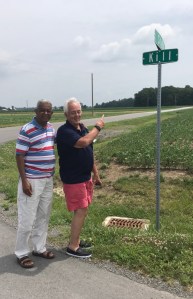 There is even a favorite bar called the Town Tavern, where we lunched with Bob’s two sisters, Cindy and Linda, his niece Stacey and nephew Philip. We feasted on the tavern’s “signature dish” of Fried Bologna Sandwich.
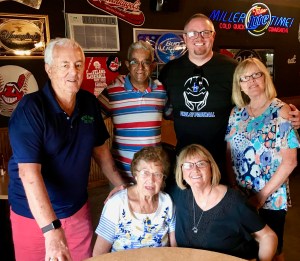 The locals say “Baloney.” Certainly not a healthy choice, but that sandwich was scrumptious. From the nonstop merriment of laughter, it was clear that the sisters adored their older brother. And being in this lively group, I felt like part of the family as I listened to family lore. Cindy and her family lived in Landeck when she first was married. Bob told the story of a family gathering on the same day as President Ronald Reagan’s “Hands Across America” promotion. It was said that Cindy and her family only needed two more people and they could have had a Hands Across Landeck celebration.
Before heading home we made a brief visit to the towering Catholic Church of St. John the Evangelist in Delphos. The sanctuary with its stained glass windows and religious icons invited the visitor to prayer and reflection. The soft glow of light filtering throughout the large church signaled peace and serenity. Mindful of the generations of hardworking immigrants who worshipped here and their descendants who still do, I lingered for a while in prayerful meditation before saying farewell.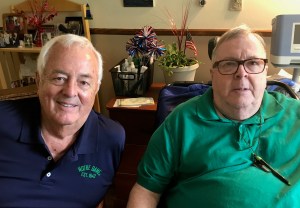 We stopped in Fort Wayne to visit Bob’s brother, Denny, who is in a nursing home. We were then off to Granger where we arrived at 6:00pm, the exact time that we had promised Melanie.
Our fall travels were grandkid visits to Portland and D.C. Reading, board games, swinging in the park, hikes, coloring, riding bikes, bedtime stories and hanging out with Mamie (Melanie) and Papi (Alfred) kept grandparents and grandchildren occupied and exhausted. In D. C. Melanie and I visited for the first time the African American Museum. After four hours, we had not yet visited the entire museum. There is so much to see and learn. We’ll definitely return. On our first day in Portland, we had lunch with Paul, Katie and her parents on what was their last day in the city. They were heading back to northern California, Crescent City, where Katie’s parents live, after visiting Katie’s sister who lives just across the Columbia River in Washington.
Later in the fall, we were back in Boston for my prostate cancer operation at Brighmam and Women’s Hospital. My surgeon from Dana-Farber was a Canadian-born Vietnamese. My surgery happened on Veterans Day. That he was Vietnamese and I, a Vietnam Veteran, added to the day’s significance. He seemed touched by this, particularly when I said to him that he and I had come full circle. Seven months have passed. I’ve recovered nicely with no imminent signs of cancer.
It’s now mid-July and Covid-19 has America captive. And although many states are opening up, Melanie and I stay close to home. When we do venture out, we take all the necessary precautions, face mask and hand sanitizer. If we must enter a public building, we do so cautiously and leave quickly. Our Baltic Sea cruise and visit to France have been postponed, and we are hopeful that a vaccine will allow us to set sail next summer. Since the pandemic is running amok with no signs of abatement, even travel to see our grandkids, whom we miss terribly, is risky. For now, we are content to visit with them via Zoom, FaceTime or Google Chat. And memories of voyages past and still to come keep me adrift in pleasant reverie. Such is my world.
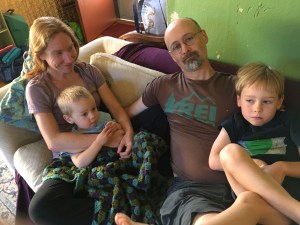
Ethan, Nicole, Eliot, Theron
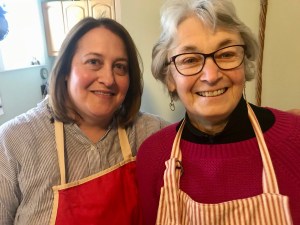
Amanda and Melanie
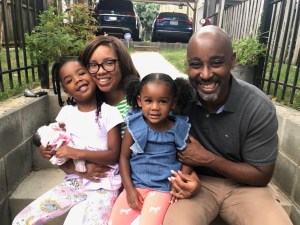
Alfred, Nashida, Michelle, Juliette
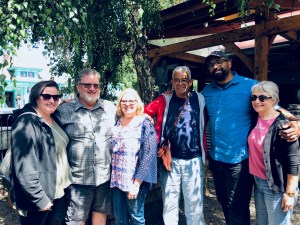
Paul with in-laws
Dear Mother
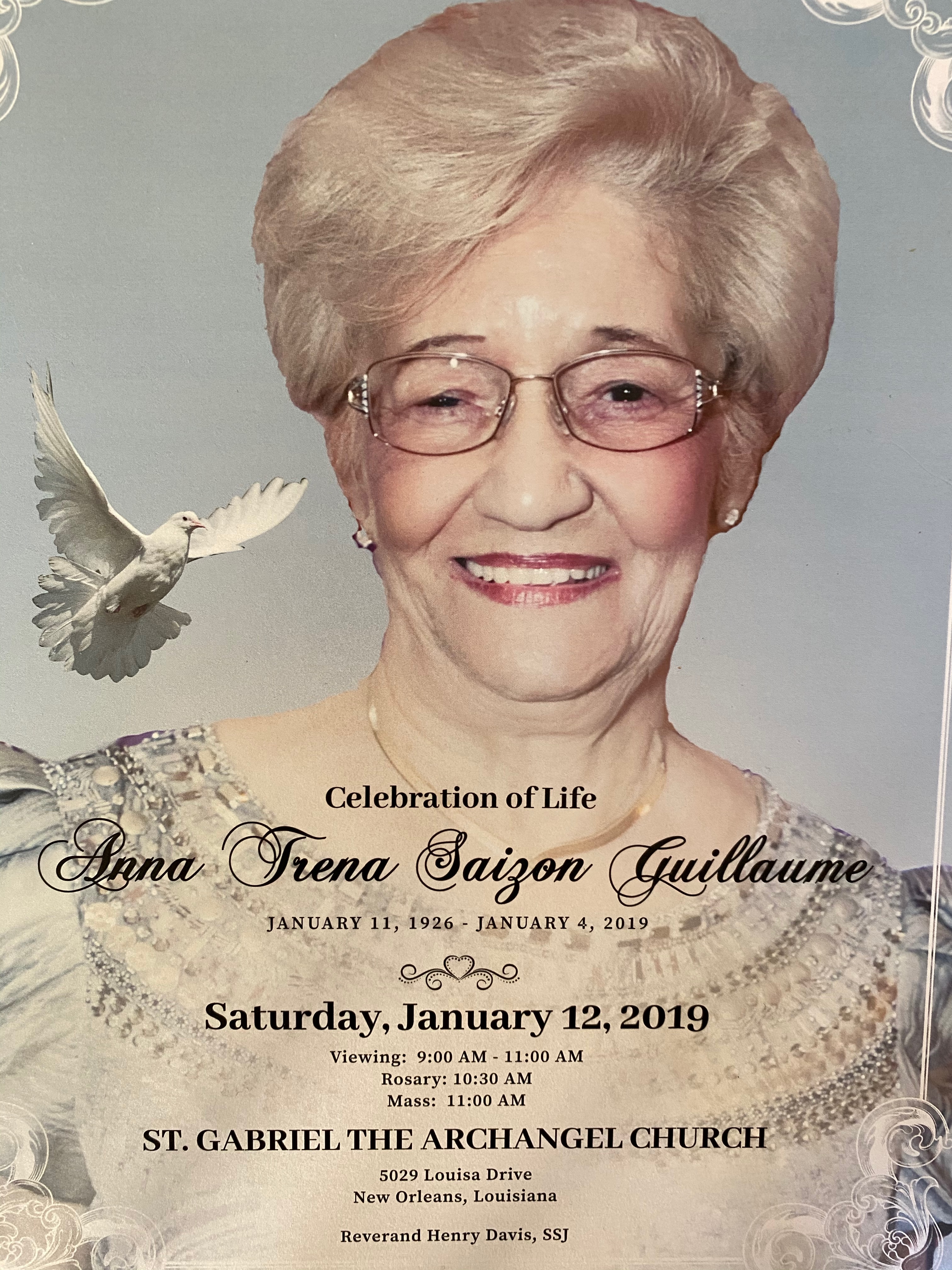
May 10, 2020
Dear Mother,
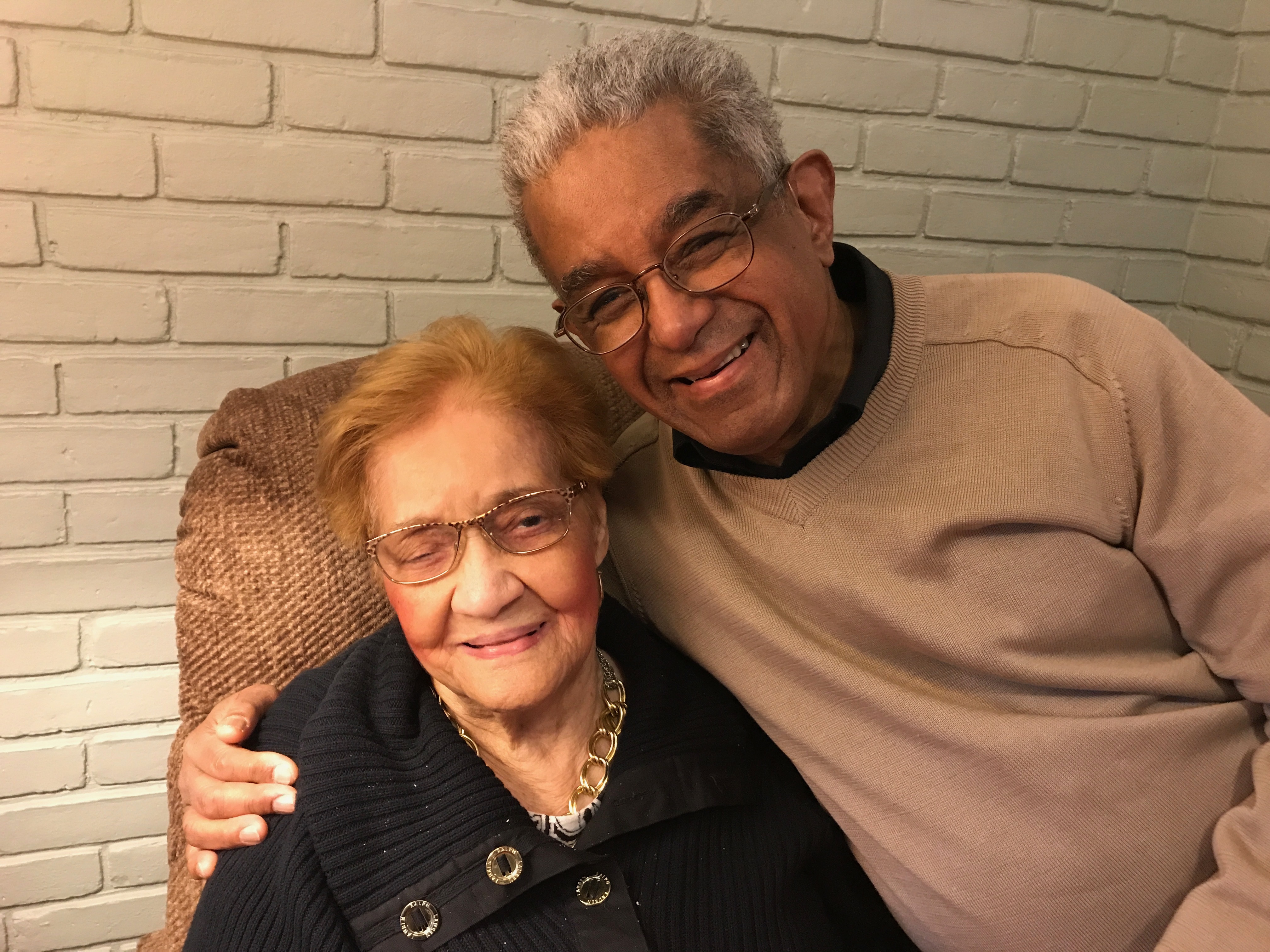
Today is Mother’s Day. I’m thinking of you as I’ve done every day since you left us sixteen months ago. My memories of you are a constant companion that bring joy and consolation. Yet the emptiness lingers. My salve is a lifetime of memories that soothe my soul, a trove of happy moments together. I remember fondly the last family Thanksgiving that all of your five children celebrated with you. Your health was failing and each of us sensed, but never voiced it, that this could possibly be our last holiday together. Each of us, including your daughters-in-law, spent time alone with you. I cherish particularly that afternoon when you and I were in the sun room. You were not very talkative then, your mind wandering in its own private world. We looked at each, neither of us saying a word. I held your hand and when I did speak about past events in Daddy’s and your life together, you smiled. On the eve of our return home, we went to your room to say good night. You had just finished your prayers. You held each of us tightly, not wanting to let go. You told us in a strong, but emotionally full voice, that you loved us. We kissed you good-bye and voiced our own love for you.
Several months after your funeral, Teri sent me a box full of items you collected over the years, a potpourri of letters, cards, newspaper clippings, papers I’ve written, chronicling my personal and professional life. You had similar files for each of your five children. In that box I discovered several Mother’s Day cards I had sent to you. I repeat partially the script from one of those cards, “…my heart will always be filled with the joy of knowing your love. It is the most precious gift I have ever received, for it is the one you have so wisely taught me to set free and share with others. I love you for being a caring person, a remarkable woman, and an exceptional mother. This love that you have given will forever live within me. Thank you for being my mother.”
Mother, in my eulogy on January 12, 2019, the day after your ninety-third birthday, I expressed that love and gratitude.
Eulogy of Anna Trena Saizon Guillaume:
We as a family mourn the passing of our mother, mother-in-law, grandmother and great-grandmother. But though we mourn, we celebrate her life and we are glad with all our hearts for the love and devotion she gave to each of us. We celebrate her goodness, her kindness to others, her gentle nature, and her elegance. We exult and we are glad that she is with God. Her entire life has been a testimony to her love of God. Her fidelity to her faith was manifest in the way she lived her life – a joyful life of a devoted, devout woman. It was that unconditional love of God and of family that she instilled in each of us. Every morning and every evening, she prayed to God to watch over her children. As she would say, “I begin with the oldest, Alfred, and pray for you and Melanie and your children and my great grandchildren, and then I go down the line to Rhaoul and Geretta, and do the same thing for Cynthia and her family, for Teri, then for Warmoth and Laurie and their family. And she would say that God has never failed her. In the year I spent in Vietnam, she went to Mass every day for my safe return home. She and my father were fond of saying that they had five jewels, each different, each special. They believed in the promise of a good education and instilled in us that we could be anything and achieve whatever we wanted with discipline and determination. Another gift that they gave to us was respect for self and for others, to accept everyone, no matter their race, creed or status in life.
When we visited her for Thanksgiving, I had an inkling that her time was near. In one of our conversations, she asked me to tell her something about our dad. I told her how the two of them loved to dance. And indeed they were remarkable dancers! “Misty” was their signature tune. So I played Johnny Mathis’ version of Misty for her on YouTube. Her face lit up and she began to sing the words as she rhythmically slapped her thigh. Then I played Nat King Cole’s “Unforgettable” and Dinah Washington’s “What a Difference A Day Makes.” She knew all the words. The sparkle in her eyes and the expressive joy on her face will be indelibly stamped in my memory and will forever resonate in my heart. We love you, Mother. You are unforgettable! Dance in Heaven with Dad!
Love, Alfred, Jr.
Birthday Pandemic Reflections
Today is my birthday, April 10. I am now 73 years old, but if I reverse these numbers, I am only 37. Even if I could go back in time to that age, I am not certain I would want to. What’s the point? My second son was not yet born, I was living in New Orleans, still green as a liberal arts dean and I had not yet imagined the trajectory of my personal and professional life – divorce and remarriage, career shortcomings and grand successes. Through them all, I’ve emerged a stronger person, more deeply rooted in knowledge of self, content to be who I am, and more intimately connected to the world about me and to the hereafter that my faith affirms will be there when my earthly being ceases to be.
Since today is also Good Friday, holding firm to that belief brings comfort, particularly as Covid-19 ravages communities across the globe. Inner prayer and meditation on this the holiest of day in the Christian calendar keeps me in communion with the suffering and dying. Like Camus’ plague in the novel of the same name, Covid-19 is indiscriminate, bringing its sting to the rich and poor. Unfortunately, in the United States, because of systemic, underlying health issues—obesity, diabetes, hypertension– people of color are dying disproportionally. Seventy percent of those dying in southern Louisiana are black, an urgent call to action that healthcare for all is sorely needed in this country. American deaths have already surpassed those in Italy. And the numbers climb.
Worldwide, the pandemic has altered the rhythms of daily living. Melanie and I are in our fifth week of sheltering-in-place. Our days were once full of civic and community engagement – board meetings, volunteering, church, politics, social gatherings and all the things needed to maintain a household. All of that has come to a screeching halt. Virtual realities now replace physical interactions. Grocery shopping is done online. Board meetings are held through Zoom. Each Sunday, Melanie and I attend virtual church services—she, the First Unitarian Universalist and I, a Catholic Church wherever Mass is celebrated. I’ve been to Mass in D.C. and in Houston. I’ll tune in to Mass at the Vatican on Easter Sunday.
Though we miss our normal daily routines, we welcome the slower pace of our lives and treasure the time that we have together. We have more time for conversation. We pass our days reading, playing cards, board games, exercising and just being. Long neglected chores like clearing our closets and files are getting attention. I’ve had more time to dither in the gardens. I’ve cleaned out the autumn leaves, weeded and expanded one of the beds. Melanie has rediscovered sewing; she has made face masks for each of us and is 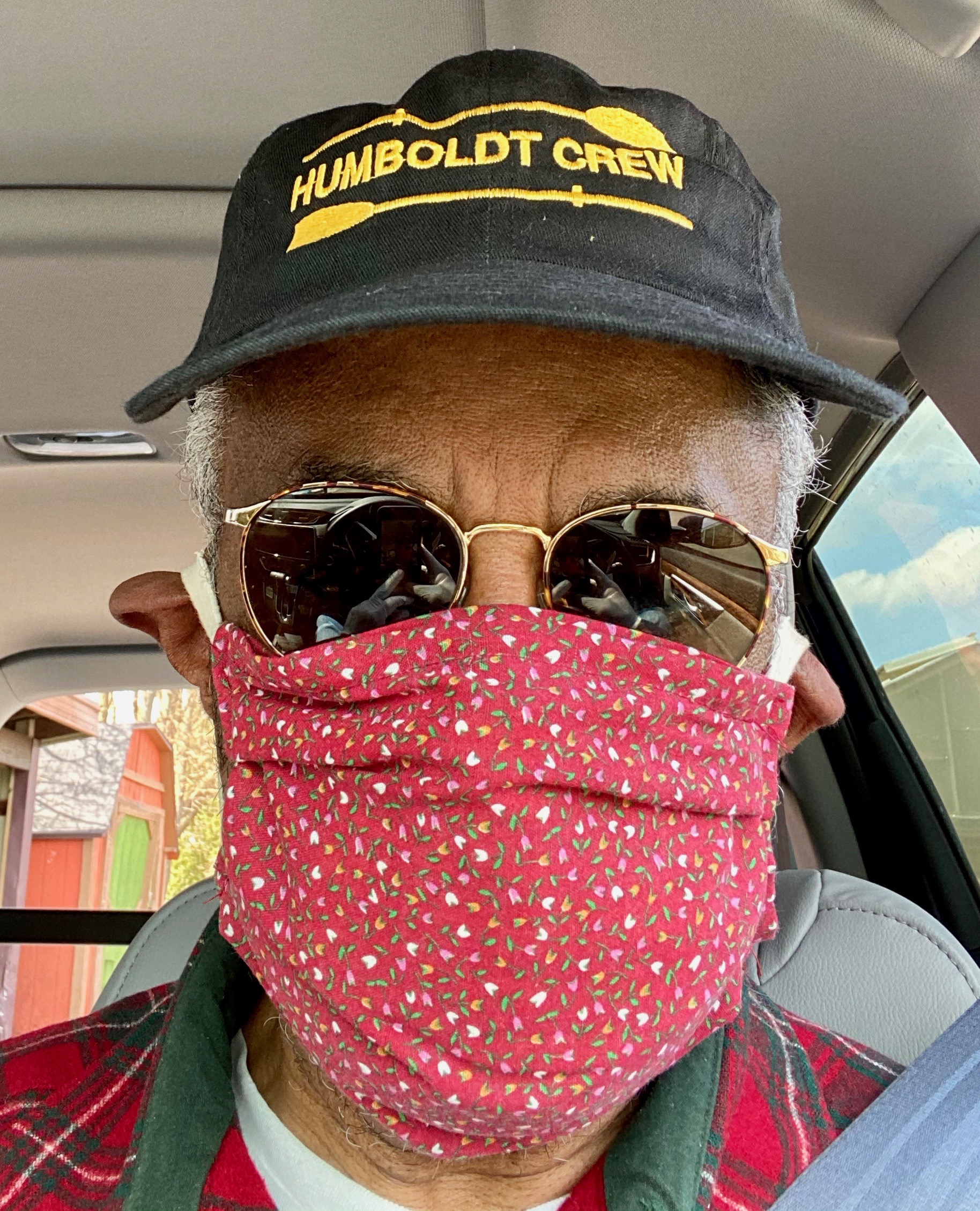 finishing a pillow covering that she began twenty-five years ago. Our appetite for reading has expanded voraciously. She’s been reading mysteries for which she has an insatiable appetite; she’s even listening to one on Audible. I’ve been reading, actually re-reading, Confederacy of Dunces, the last novel of four for the one-hour graduate class I’m teaching, “Literary New Orleans.” I just finished reading Toni Morrison’s Paradise, a novel that I will need to re-read sometime in the future to better appreciate it. Morrison is a beautiful writer but her novels, like Beloved, demand slow thoughtful reading. The New York Review of Books keeps me entertained as well. I’ll begin reading soon a young adult book, Where the Mountain Meets the Moon by Grace Lin, that Melanie has read. It’ll be a conversation piece with the grandsons in Portland, Oregon whose dad has already read, and is re-reading, to them. It’s a chapter book that both of the boys, aged 7 and 3, have enjoyed listening to.
During our daily walks there is a disquieting silence around us. On some days, there is an eerie ghost-like feel to the streets, few people outdoors, even fewer cars. A welcome respite from the usual cacophony of noise. Occasionally, kids on bicycles zoom by skirting the outer edges of the street, politely maintaining distance. On sunny days, more neighbors are about, conversing across streets, from driveway to driveway. Chalk art and messages adorn wide expanses of concrete — a wand from which floats dozens of bubbles, a colorful chalked message of thanks to all first responders and healthcare professionals. On another driveway, a take on a springtime ditty reminds us, “April distance brings May existence.” On a corner lawn, placards on upright poles entertain walkers daily with a new riddle like, “What does a cloud call his shorts? Thunderwear,” or, “What did a hamburger name his daughter? Patty. “ 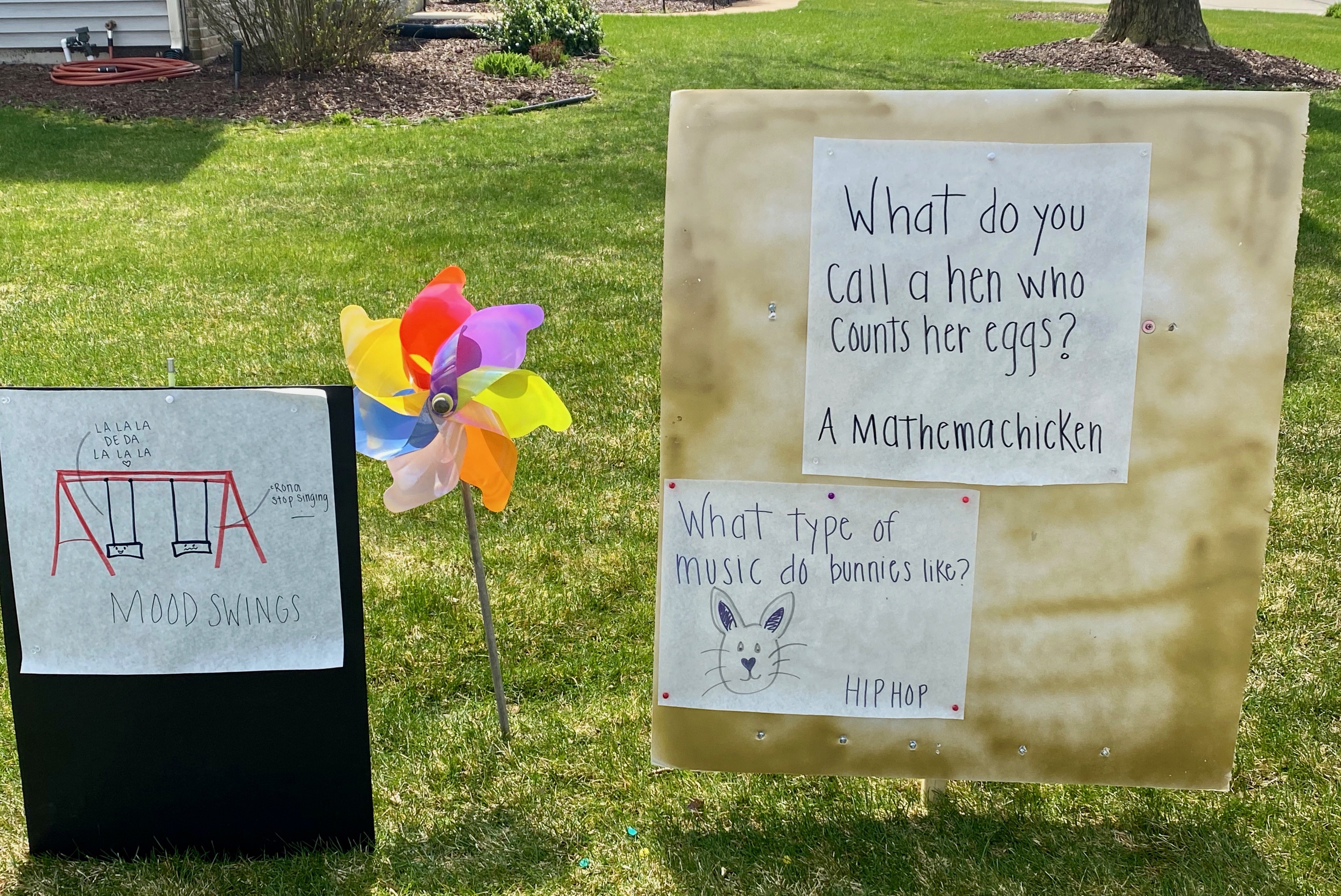
Perhaps it is imagined or willed, but it seems that in our isolation, neighbors are more mindful of each other. As the elderly couple in our cul-de-sac, neighbors ask if we need anything. And we don’t. We’re still able to fend for ourselves. Yet, on Saturday morning, two large rolls of paper towels mysteriously appeared at our front door. From whom? Is the pandemic making us all gentler, kinder, friendlier? If so, it’s refreshing. But will it last beyond the pandemic’s end? For certain, life will be different. There will be new norms in social engagements, business practices, and educational delivery. Virtual reality has already changed our behaviors.
Over these last few weeks of isolation, Melanie and I have made more frequent phone calls to elderly friends across the country, shared virtual cocktails with others from Taos, New Mexico; Ashland, Oregon and here in South Bend. We’ve done Zoom or FaceTime visits with children and grandchildren in D.C. and Portland, Oregon, and celebrated my birthday over a surf and turf dinner from LaSalle Grill with Mike Keen and Gabrielle Robinson, good South Bend friends, who also ordered dinner from the same restaurant. A delicious bottle of Chateauneuf-du-Pape, a gift from them that they had also, made the meal even more special. Over the weekend, a dear friend from southern France called, and this Easter afternoon we received a surprise visit via Skype from Melanie’s sister-in-law and sole surviving brother.
When this time of mandatory isolation is done, I’ll welcome elatedly real time gatherings with friends and family, parading down grocery aisles aimlessly, walking across the street to greet my neighbor, attending Sunday services in communion with others, traveling highway or aeronautical miles to hug loved ones, and ,simply being at my downtown “office” at Chicory Café, reading a book or greeting others.
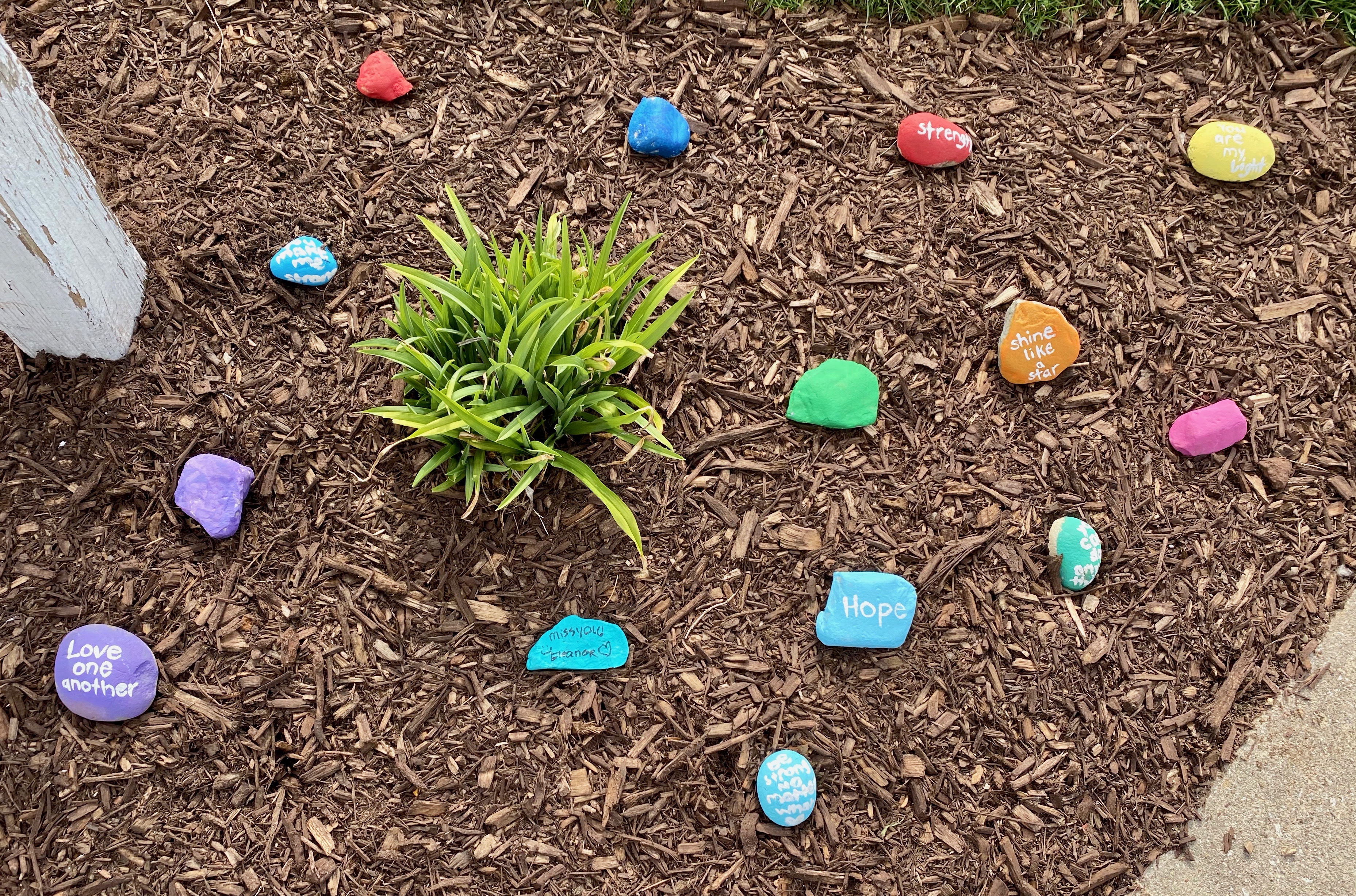
Along our walk, painted messages of hope.
Hail! All Hail! XU
The weekend before last Thanksgiving, Melanie and I drove to New Orleans to attend my 50th college reunion at Xavier University in New Orleans. In freezing rain and snow, we were compelled to drive no more than forty-five miles per hour between South Bend and Indianapolis. Along the way, we saw cars stranded in ditches. Several miles earlier, one of those had sped breezily past us. We were well into Kentucky before we able to drive at normal highway speeds.
Before and during the drive down, I had ample time to reflect on my college years, 1964-68. Since I had spent most of my high school years in seminary in the Hudson Valley, I had no clue about what to pursue as a major. My mother wisely suggested that I study what I enjoyed, noting that success would follow. I had always enjoyed reading and the power of words, so I decided to major in French language and literature. The rest is history. Now in retirement, after a successful career in academic administration and teaching at two Catholic and two public universities, I consider myself fortunate. Over the years, I’ve thanked my mother for her priceless advice. When I expressed my gratitude to her for the very last time during my Thanksgiving visit, she smiled meekly. I knew then that her time to leave us was nearing. Several weeks later shortly after the New Year, we returned to New Orleans for her funeral. She was buried the day after what would have been her ninety-third birthday.
As an undergraduate, I was addicted to the smooth rocking Motown tunes of Smokey Robinson and the Miracles, the Temptations, Martha and the Vandellas, Diana Ross and the Supremes. The raw, bluesy soul music of Otis Redding, Wilson Pickett, Percy Sledge and Jackie Wilson thrilled me. We danced the Bunny Hop, the Hitchhike, the Twist, the Locomotion, the Monkey, the Limbo , the Hucklebuck, the Mashed Potato, and the Jerk . We imitated the gyrations of James Brown. And in New Orleans-style, we did the Alligator, a sexually suggestive dance of writhing bodies hovering just over the floor boards. And of course, when the trumpet hit the high note, we danced gleefully the inimitable traditional Second Line to the tune of “When the Saints Go Marching In.” Etta James , Gene Chandler and Jerry Butler sang mournful ballads as we moved slowly, rigidly in place, with our dates. American Bandstand was on the wane and Soul Train on the rise. Saturday night dances at the Barn (Xavier’s gym) with music by the Royal Dukes of Rhythm , were jam packed with sweating bodies.
But those years of collegiate mirth were years of intense civil unrest. All across the South, citizens of all races and ethnic groups marched in protests against odious racial injustice. On TV screens, Americans watched in horror the burning buses of the Freedom Riders, the brutal beatings by police of civil rights workers and the eruption of riots in inner cities. We mourned the slayings of Goodman, Schwerner, and Cheney, of Medgar Evers and Martin Luther King, Jr, and then Bobby Kennedy. America was in turmoil over the Vietnam War; the Women’s Movement too was taking root in the struggle for equality. Martin Luther King’s vision of of a beloved community in America was shattered by his tragic murder in 1968. As cities burned, I remember Bobby Kennedy’s comforting words in Indianapolis as he urged black Americans not to seek revenge while recalling his own brother’s tragic murder. At Xavier’s Barn, the student body gathered in prayer as we listened to then dean of students, Norman Francis, urging us not to give up hope, reminding us too of our responsibility to continue Dr. KIng’s dream of living in a society where we would be judged by our character, not by the color of our skin.
Much has happened in the span of those fifty years. The Class of 1968 did fulfill Dr. King’s dream of extraordinary achievement for black people as we became leaders and high achievers in our respective professional and personal lives. As we met and basked in fellowship, in telling and re-telling of events and stories, we were painfully aware, in thought and words unspoken that our nation within the last two years has regressed shamefully in its progress toward racial harmony and justice. Notwithstanding, we were happy to see each other, our friendships rekindled as if the span of time were non-existent. Remarkably, age has been kind to us. Our septennial bodies relatively still in good form.
The weekend began with a Friday night social with music by a DJ. Since no one was dancing, Melanie and I suggested ballroom dance tunes for him to play. Our foxtrots, waltzes, and tangos delighted those in attendance. Even the DJ came over to show his appreciation and thanked us. Festivities continued throughout the weekend with small gatherings, lunches, basketball game, campus homecoming and cookout, evening banquet and finally with Mass celebrated in the beautiful St. Katherine Drexel Chapel. Replete with African style dances, gospel hymns and a spirited sermon by the celebrant, who was an undergrad during my time at as dean of arts and sciences at Xavier, the Mass was a joyful celebration.


There’s not much to remember about our college graduation. There were the usual pomp and circumstance, the parade of graduates on stage receiving diplomas, the requisite congratulatory handshake from the president of the university and the awarding of honorary degrees . But I do recall one remark by the commencement speaker. Since our generation viewed anyone over thirty as “over the hill” and not to be trusted, he reminded us that we would soon be “over the hill.” We chuckled. Young, vibrant, and eager to make our mark on the world, we thought thirty years of age seemed eons away. I’ve recounted this story countless times to undergraduates over the years, always eliciting laughter.


I am deeply grateful for the education I received at Xavier, the only black Catholic university in the western hemisphere. It was there that my love of the humanities and the arts was nurtured. As a child, books were my friends. Every week during the summer I visited the bookmobile for Coloreds, usually parked under a large shady tree in my elementary schoolyard. Mrs. Roussève, the librarian, always eager to see me, suggested books, typically history and biographies. I read insatiably. At the end of each summer, I received a certificate noting the number of books I had read.
One of my memorable courses as a freshman was an interdisciplinary course, Humanities 101, that blended literature, the arts, philosophy and science. Each week in the campus auditorium, a professor from various disciplines lectured. It was this seminal course that has had the most profound impact on both my personal and professional life. It set in motion the basis of my intellectual rigor, my moral foundation and the way I conduct my life.
My language courses with Dr. Baisier, Sr. Augusta and Dr. Mace were pure joy. Most of the students were women. They were equally bright and beautiful. They challenged me and I had to work hard to keep up. I remember fondly Helena, Myra, Penny, Elise, Eileen. Among them, only Penny and Myra came to our fiftieth reunion. We shared stories and laughter about our favorite professors. Since Dr. Mace’s literature classes were entirely in Spanish, I tried, much to his vexation, to secretly record his lectures. He, on the other hand, preferred that I listen attentively and take notes. Dr. Baisier, a French Resistance fighter, always serious in the classroom, spoke an elegant Parisian French, but would often revert to English. When we began as freshmen, Xavier was entirely black in its student composition, and the majority of faculty, including the nuns, were white. They were devoted to us and firmly committed to making a difference in our lives. They believed in our moral, social and intellectual development during a time when our country was struggling to consider black and white people as equals. Thank you St. Katherine Drexel and the Sisters of the Blessed Sacrament.
Xavier University of Louisiana and I share an indelible bond. Wave her colors, bear them onward/Gold and White so true! Hail XU!


Provence to Sardinia
PROVENÇAL IMAGES


Before embarking on our journey to Sardinia with three friends from Le Pradet, we spent two weeks reconnecting with the pace of life here. Since retirement we’ve been coming to Provence every twelve to eighteen months. Beyond the delicious Provençal dishes and the ever-pleasing regional rosé, what attracts us most to this region are the wonderful friends we’ve made over the years. With each visit, our circle of friends and acquaintances grows, and so do our dinner invitations. In the days before and after our visit to Sardinia, we’ve been feted royally, happy beneficiaries of the delectable Provençal cooking that our friends are so rightfully proud of. As in many cultures, food in Provence is essential to the intimacy of family and friendship.
A new experience for us was an evening with neighbors at a street party, une fête de voisins. Our friend, Martine, who serves as the neighborhood association’s president, called the gathering une fetê de civilité, ostensibly to smooth ruffled misunderstandings among neighbors. 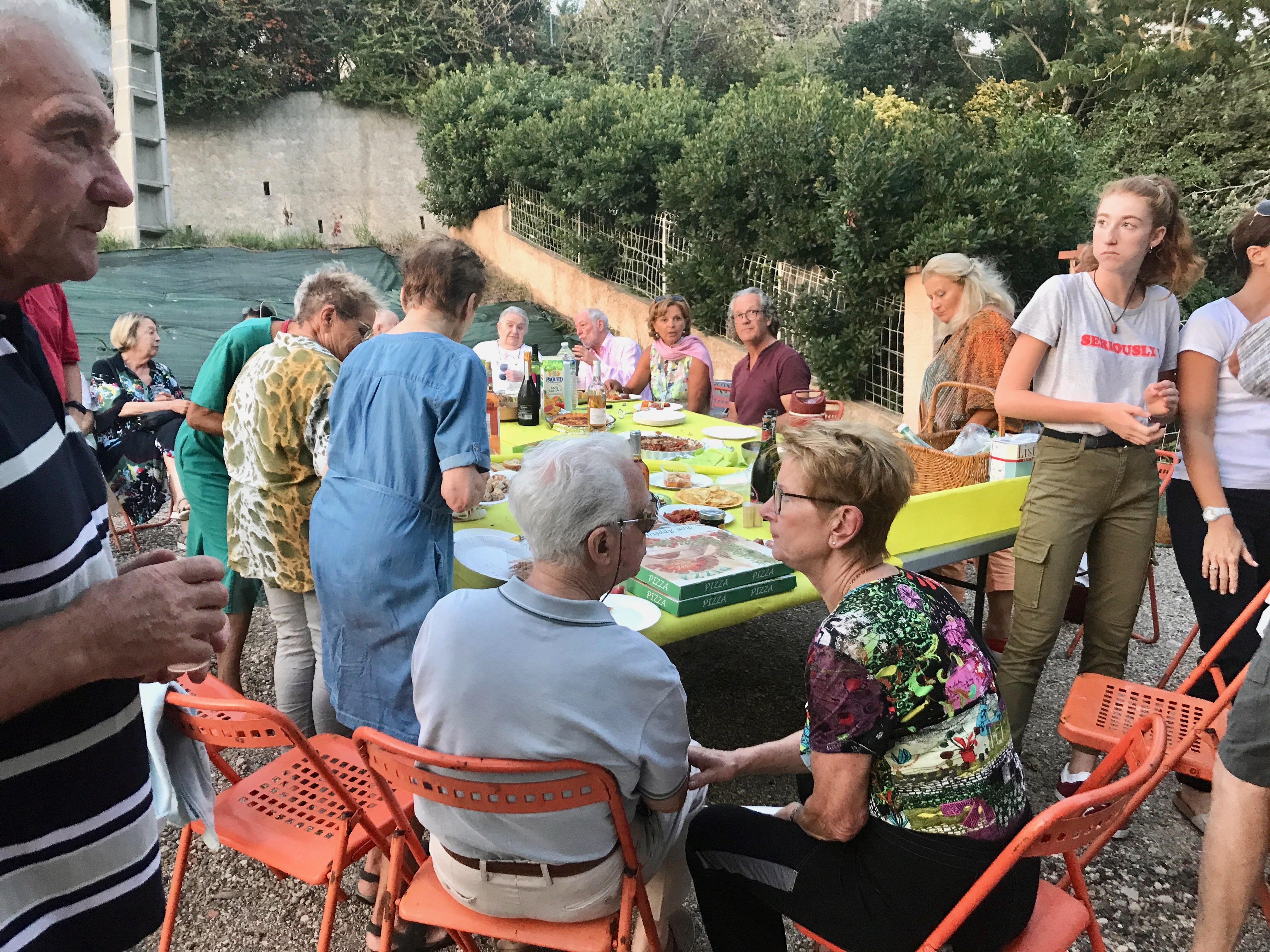 That evening we met a gentleman who shares my surname. Olivier is a retired airline pilot, who lived for many years in Los Angeles. He and Marc, another neighbor who builds model airplanes and whom he had not met before, had a spirited conversation for most of the evening.
We spent another memorable evening of fine dining with our friends, Catherine and Jean-Louis. About six months ago, they sold their wine vineyard and are now living in a large old house on the west side of Toulon, tucked among the trees behind a row of tony apartments. We had difficulty finding it. Missing from Catherine’s detailed directions was a turn into a long walled alleyway leading to their home. Their house number did not appear on the main street although our GPS indicated that we had arrived. Our mobile phone came in handy; Jean-Louis came out to greet us. As we’ve come to expect, dining at Jean-Louis and Catherine’s is never a small gathering. They’ve always had us over for a barbecue in their vineyard with a large group of their friends. This time our dinner was more intimate, and included Catherine’s sister, Martine, and brother-in-law, Pascal, from Marseille and another couple from Hong Kong, Anthony, an Australian, and his Chinese partner, Ernest. While waiting for another guest to arrive by train, we sat chatting in the garden under a beautifully moon-lit sky with appetizers and wine for almost two hours. The other guest finally could not make it, so at ten o’clock we began our meal with eggs and wild mushrooms, followed by a delicate fish stew over rice , and naturally a cheese course before having a clafoutis for dessert. It was well after midnight by the time we returned home.
A few days later, we drove to Juan-les-Pins to lunch with Alexandra and her mother, Célestine. (Alexandra was Melanie’s ESL student many years ago in California. She and her husband, Jean-Luc, and son, Victor, visited us this summer in South Bend. They produce champagne and were on a business trip to California to meet other producers and importers.) Alexandra flew down from Verzenay, to join us, a visit that pleasantly surprised her mother. Célestine prepared one of my favorite dishes, paella. What a feast!


On another wonderful day of dining, we grilled our food at the table at Natacha and Nicolas’ home. They too, with their daughter, Marie, will be in Sardinia later in the month. This evening we are going to their home, and over apéro, will share our Sardinian adventures with them. The family came to dine with us in Granger last year when Natacha was an exchange prof at IUSB.


Another new experience for us was participating in the weekend of celebrating the patrimoine, the annual celebration of France’s cultural heritage. In its thirty-seventh year, twelve million people visited over sixteen thousand monuments. With our friends, MariThé, Christian and Martine we visited two small villages St. Martin de Pallières and St. Julien Montagnier. At the former, we explored a twelfth century castle with a guide who grew up there. It was particularly fascinating to hear his boyhood adventures boating by torchlight in the castle’s underground cistern. In the latter village, we explored the narrow streets and the original windmill that is still standing.


Just over two years ago, we traveled to Corsica, and now with our friends, MariThé, Christian and Martine, we took the overnight ferry to Ajaccio. Once we settled into our cabins we all went to the dancing bar for drinks. Christian introduced us to Spritz, an orange flavored Italian liqueur, a bit sweet but refreshing. There a duo, a singer and guitarist, with programmed rhythm accompaniment, played wonderful ballroom dance music. Naturally, Melanie and I danced between the row of tables. We chatted with the singer, Mariella, But since the ferry crew and the musicians were Italian, we managed to communicate using French, English and gestures. Mariella told us that work for musicians in Italy is scarce. 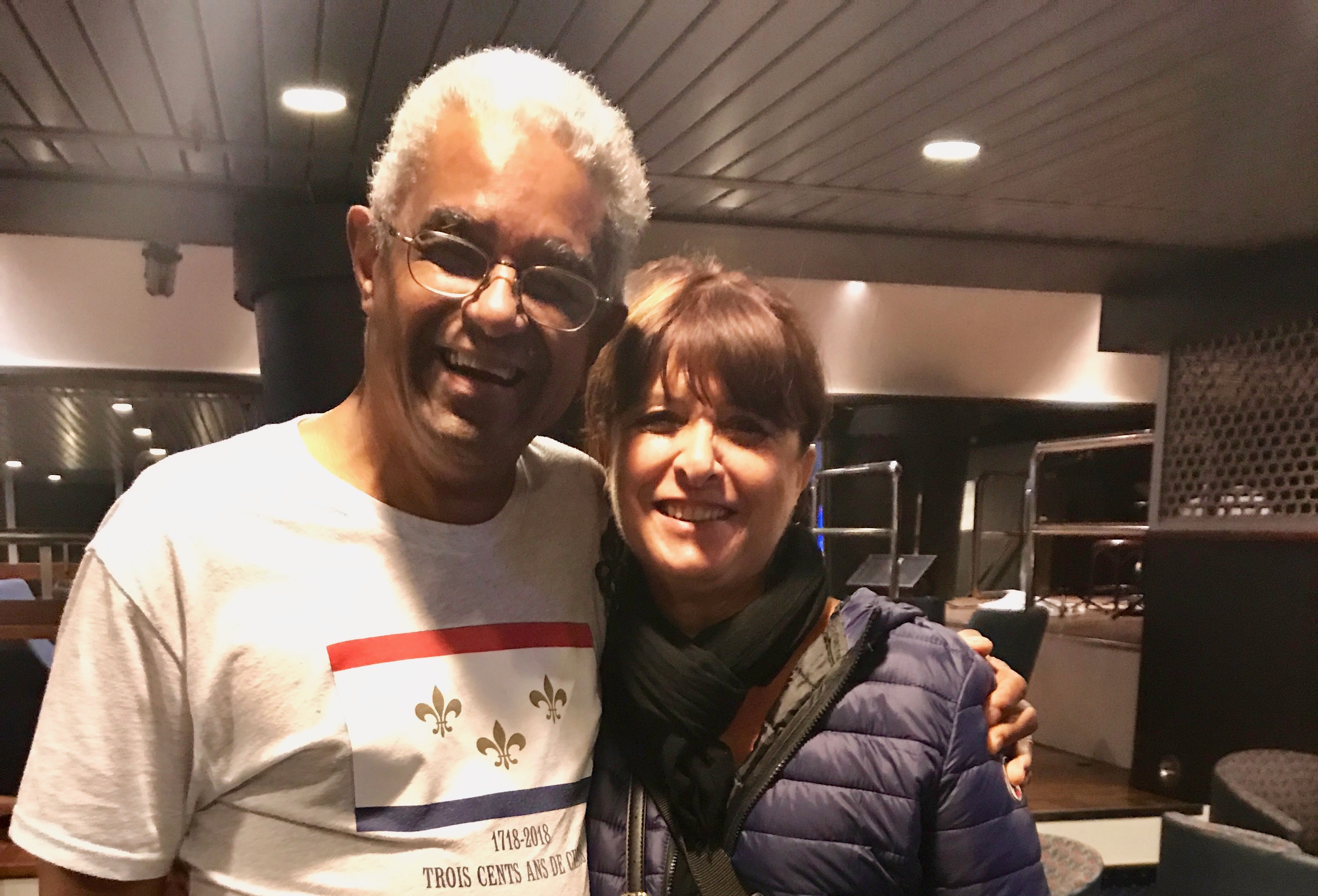 She’s from Milano and would like to come to America. We all laughed with her when she asked us in a deadpan voice to find her an American husband. She told me to show her picture to any interested men when I returned to the States. Later, I sent her a copy of the picture for which she thanked me, and in her note wondered if we had enjoyed our trip to her country.
Once we reached Ajaccio, we drove south to Bonifaccio for the one hour ferry ride to Santa Teresa di Gallura in Sardinia. Before boarding, we had lunch with our friends, Marie-Jeanne and Guy at their home in Porto Vecchio. Joining us were their son and daughter-in-law, Pascal and Catherine, a couple of their neighbors, and Marie-Jeanne’s brother, Dominique, whose basement apartment we rented two years ago. Dominique is celebrating his ninety-first birthday this month.


Marie-Jeanne and Guy live in Paris, but spend several months at their Corsican home. On a clear day, which it was, the coastline of Sardinia is visible from their patio.
SARDINIAN IMAGES


My first impression of Sardinia was that it was similar to Corsica, but after several days I concluded that Sardinia was less mountainous. As we drove along the coast to Alghero where we would spend the next five days, I noticed patterns of slightly ascending and descending slopes. The serpentine curves were fewer and less sharp than in Corsica and the hills were not nearly as steep. The terrain was more open; expansive flatlands were bordered in the distance by low level mountains. I noticed many small farms with cows. Christian believes that many of these homes are not farms at all and he conjectured that homeowners have cows so that their property can be labeled farms in order to lower their taxes. Whether this tale is true or not, it is quite clever.
Culturally, I found Sardinia to be more closely linked to Italy than Corsica is to France. Corsicans have a strong emotional bond to their island culture that places it ahead of their French citizenship. And although there are Arabic and Catalan influences in Sardinian culture, I sensed little traces of a cultural conflict with Italy. To me, the cuisine was clearly Italian with touches of Sardinian flavor. And I did not sense from the locals a Sardinian vs Italian identity. But what was most fascinating to Melanie and me were the archeological sites of the Nuragic civilization dating from the Bronze and Iron Ages. In Alghero, we visited several Nuragic ruins, the most interesting of which was the Palmavera, one of the most intact archeological sites in the country. We gleaned what Nuraghic daily life night have been like as we ambled through narrow corridors examining living quarters and peering into storage rooms that housed grains and other provisions. Also near Alghero, we visited a pre-Nuragic burial place, the Necropolis Anghelu Ruju. Toward the east of Sardinia we visited in Arzachena, the Tomba Moru, known as the giants’ tomb, elongated burial chambers of stone slabs where dozens, even, hundreds of bodies were buried. At some sites we saw petroglyphs.


I enjoyed roaming around the old city in Alghero. In spite of the ubiquitous boutiques that cater to tourists, the old stone houses along the narrow streets retained the city’s medieval charm. Residents of this port city are extremely open and friendly. On our first day in search of the Office of Tourism, we were given five different directions, all with certainty and a smile. And we still got lost. Surely, our difficulty was not in properly understanding the directions; MariThé is multi-lingual. In our wanderings, we stumbled upon a newlywed couple from the Czech Republic who were paying for their honeymoon traveling throughout Europe by playing in the streets. She was a professional musician and he, a very capable amateur. We enjoyed our chat with them. I gave them some advice about a happy marriage and left them a good tip.


The city also has character. Colored photographic portraits celebrating the city’s centenarians along the walls of some buildings told more about the city’s values than any tourist brochure. One evening at San Miquel Church we attended a polyphonic concert of two choirs. The first choir sang secular and religious hymns. The harmony of their voices gave an orchestral sound that filled the church. The second choir was exclusively male that sang in a circle with the choir director in the center, a style of singing that I had never seen before. The effect was that of voices projecting upward before spilling outward over the audience. The consequent resonance of their voices gave me chills.
Alghero has roots in Arabic and Catalan culture, the historical influences of which still remain in its architecture, its food, its customs. Some residents still speak Catalan. Italian, of course, is the lingua franca. I loved listening to the locals speak. One afternoon seated on bench at the port, I listened to a gentleman during his phone conversation. The rise and fall of his voice coupled wth the expressiveness of his body gave an operatic quality to his speech. In this very Italian city, attached to the bench where I was seated, was a plaque in French with these words, “J’ai deux amours, mon pays et Paris. Mon âme a son secret; ma vie a son mystère.” (I have two loves, my country and Paris. My soul has its secrets, my life has its mysteries).
What I’ve come to appreciate traveling in Europe at this time of year is the paucity of tourists. The second most common language I heard was German. The Germans seemed to be everywhere, many with children in tow. I learned later that the German schools were on holiday. If I had’t heard them speak, I would have easily thought they were locals. They blended in with many of the Italian families I saw walking around in the late afternoon along the port and in the old city.
From Alghero, we took a boat trip to the Grotto di Nettuno, first explored in the 1740s. Our guided programmed tour took us through about 600 feet of the grotto’s 8,200 feet.


Since pictures were prohibited in the interior, my only picture of this beautiful space is at the entrance. Our boat trip over, we lunched in the old city at Al Tuguri, a restaurant that served authentic Sardinian cuisine with a Catalan touch. Recommended in our guide book, we had actually considered it the day before but for reasons which I do not remember, perhaps timing, we chose to eat elsewhere. But before leaving, the proprietor cautioned that other restaurants served food and in his restaurant we would find fine cuisine. We were not disappointed. It was the first time I had had black and white pasta. (The black side of the pasta had been dyed with squid ink. It didn’t change the taste.) Served with seafood, it was delectable. And generally, I would agree with the proprietor in his distinction between food and fine dining. Although we had tasty food during our stay in Sardinia, the only other time we had a fine dining experience was in the restaurant, SottoVento , on the island of La Maddalena. Two Sardinian wines that we enjoyed, and recommended by Melanie’s nephew, Mike, who spent four years in Sardinia with the U. S. Navy, were Cannonau di Sardegna and Vermentino di Gallura, red and white respectively.
Our five day stay in Alghero over, we headed eastward to Palau where we stayed another four days. On the way, we stopped for a visit to Sardinia’s most famous Romanesque church, Santissima Trinità di Saccargia. There in this simple and austere sanctuary, I prayed and lit a candle for two ailing friends in South Bend, Judy and John Charles. I learned later that Judy had died two days earlier.


Before reaching Palau, we spent the afternoon in Olbia, a more modern city than Alghero. We had lunch there, walked around the old city, visited the cathedral and window shopped, except for the fine linen Italian shirt with rolled up sleeves that Melanie bought for me. Palau was our home base for day trips to the islands of Maddalena and Caprera, the latter the home of Giuseppe Garibaldi, whose compound and gravesite we visited. This area of Sardinia is considered to be one of the most affluent on the island. We visited several towns along the coast, San Pantaleo, a charming village in the mountains, and Porto Redondo and Porto Cervo, chic, clearly upscale communities that attract the well-to-do and their yachts. The streets and public spaces were well-maintained and manicured. Four and five star restaurants adorned the coastline. Tony shops in Porto Cuervo like Gucci, Cartier, Versage, Hermès and Luis Vuitton were not in my price range. A mojito cost 23 euros, and I didn’t order one. I had one of the best ever in Alghero and it cost me 4 euros. I do confess to indulging in a gelato for 6 euros.
After nine splendid days in Sardinia, we traveled back to France in reverse. That is we took a one hour ferry ride to Corsica, drove north to Ajaccio. On the way, we stopped in Sartène at U Sirenu for a lunch of scrumptious Corsican cuisine including lamb brochettes cooked over wood coals in the fireplace beside our table. Fully satiated, we continued northward for the overnight ferry to Toulon. And yes, we did dance to the music of another swinging duo of a saxophonist and female singer. And no, she did not ask me to find her an American husband.
We returned to Le Pradet in time for the Annual Mussels Festival. What a feast! It’s one of the joys of living on the Mediterranean. 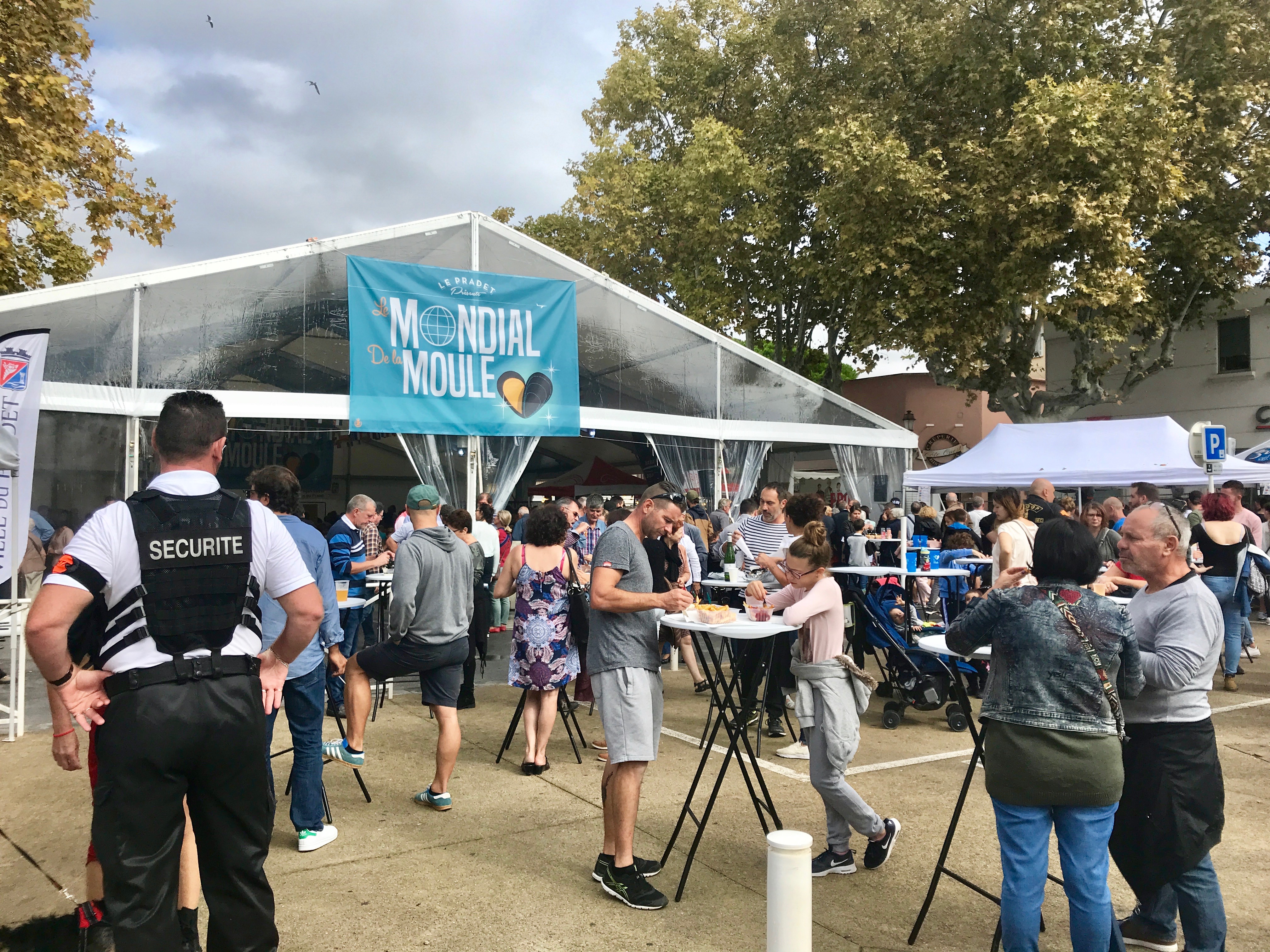 Now it’s time to think about returning home. We have one week left and there is still time to indulge my epicurean tastes at one of the celebrated bistrots in the surrounding villages.
The March Continues


16th Street Baptist Church in Birmingham, AL where four girls were killed in a bombing on September 15, 1963. Stained glass panel gift from the people of Wales.
In May, Melanie and I were invited to join IUSB (Indiana University South Bend) students, faculty and community members on a two-week Civil Rights Heritage tour. We journeyed throughout the South visiting historical sites and monuments and conversing with pioneers in the Civil Rights Movement. For many, it would be their first encounter with the deep-seated hatred of the Old South. For me, I feared reliving painful memories.
I grew up in New Orleans, where the good times roll. Then, the city was not as rigorously segregated as other places in the deep South. In many neighborhoods whites and blacks lived in close proximity. Next to our shotgun home lived a childless white couple whom we addressed politely as Mr. Arthur and Miss Gladys. Nevertheless, Jim Crow prevailed. I remember as a little boy riding the bus with my maternal grandmother when a white man removed the Colored Only sign in front of us and placed it on the back of the seat behind us. As custom dictated, we were forced to stand behind the sign since no other seating was available. On another occasion, a white policeman motioned my dad to pull his car over; he demanded his driver’s license, addressing him as “boy. ” I felt shame and humiliation.
My Civil Rights journey began as a sixteen-year old in the summer of 1963, prior to my senior year at the all boys St. Augustine High School. The previous three years, I was a Josephite (Society of St. Joseph) seminarian in Newburgh, New York, where for the first time in my life I lived in a de jure desegregated society. My return to the segregated south of Colored Only and White Only was a rude re-awakening of racial inequalities and social injustices. No longer willing to accept this as a way of life, I participated with the civil rights activist, the Rev. Avery Alexander, in voter registration. With dozens of other teenagers, we marched door to door in sweltering heat teaching mostly elderly residents of a segregated housing project the preamble to the Constitution. Reciting it without fault was a requirement for voter registration. Predictably, many were turned away, but we persisted. Ultimately, because so few were allowed to register, we began to march and demonstrate in front of City Hall chanting freedom songs. One of my favorites that gives me goosebumps even today was Oh Freedom (Oh freedom over me, and before I’d be a slave, I’ll be buried in my grave and go home to my Lord and be free). We were arrested several times, held in a holding room and then released. My protest days ended abruptly the day I was fingerprinted and released to the custody of my parents. They were horrified and worried about my future.
That 1963 summer’s march toward freedom began anew on May 10 of this year with the Civil Rights Heritage tour. As we departed at 7:15 am, I had some trepidation.  I wondered how I would handle emotionally an intellectual reentry into Jim Crow country — the separate restrooms, water fountains, waiting rooms, lunch counters, the segregated schools, churches and movie theaters. I did not expect how deeply moving this journey would be.
Our first stop was in Nashville where, in 1960, students followed the example of their peers in Greensboro, North Carolina in lunch counter sit-ins. Sit-ins and the Freedom Rides became central to the Civil Rights Movement throughout the South. On the evening of our arrival, we dined at Morrell’s on southern cuisine – roast, fried, chicken, meatloaf, collards, green beans, sweet potatoes, cole slaw, mashed potatoes, cornbread, biscuits, and peach cobbler – all served round table style. After dinner we heard from one of the original Freedom Riders, Ernest Rick Patton, who recounted harrowing adventures of his participation in the Freedom Rides. He explained the training that prepared students to participate mentally and physically, in civil disobedience, how to use their minds to remove themselves from hateful situations. The next morning our group reenacted a nonviolent protest march, walking in silence from the site of the Old First Baptist Church to the Municipal Courthouse. It was at this church that the Rev. James Lawson, who studied the teachings of Gandhi, taught workshops in non-violence. Our visit to Nashville included a stop at Fisk University where we learned of Diane Nash‘s and John Lewis’ leadership in organizing sit-ins and arranging for participants in the Freedom Rides.
From Nashville, we proceeded to Atlanta where our civil rights education began to take root. There we met Charles Person, another Freedom Rider, at the Center for Civil and Human Rights. His moving and inspirational story, like Mr. Patton’s, demonstrated the enormous capacity of the human will to endure indignities in the fight for social and economic justice. History frames the Civl Rights Movement around luminaries like Dr. King, Rev. Abernathy, Jesse Jackson, Fred Shuttlesworth, Andrew Young, Julian Bond, Fannie Lou Hammer, and Rosa Parks.  But the Movement’s impact in effectuating and radicalizing change is owed to ordinary citizens, foot soldiers in the fight for justice, many of whom will remain unnamed. At the King Center, we learned of the critical importance of the church in galvanizing small groups of students in non-violent civil disobedience. Seeing Dr. King’s boyhood home was a curious artifact, but being present in the original Ebenezer Baptist Church, as his voice bellowed messages of hope, gave me goosebumps. I reflected on the enormity of his sacrificial journey and the strength of his convictions in pursuit of justice. In the otherwise nearly empty sanctuary, his powerful voice echoed all around us.
Among the many memorable moments of our tour was our stay at Highlander in the Tennessee Mountains. It was at this rustic lodge tucked away in the wilderness where Rev. James Lawson, Rosa Parks, John Lewis and Dr. Martin Luther King, Jr learned the tools of non-violent resistance. For our group, it was a welcomed respite. In this serene and sacred space we had time to absorb what we were learning and think in practical ways about how we confront hate and prejudice. In one-on-one conversations we spoke about what we were experiencing. We gathered as a group in the great room to share personal stories about race and privilege. For some, this was an intimidating activity. Fearful of our vulnerabilities, our conversation about personal experiences of race began slowly. But as we listened to one another, trust began to build. There were painful revelations of personal failures in confronting racism; there was acknowledgement of white privilege; there were painful memories of social injustice; there was admission that heretofore little thought was given to economic inequities. There were tears, quivering voices, and yes, some laughter. In the end, our group became more confident and trusting. I imagine that those early civil rights activists, too, had to learn trust, and to overcome anxieties as they prepared for possibilities of personal bodily harm.


Reenergized by rest, and feeling enormous gratitude for the sacrifices of those pioneers in the civil rights movement, we boarded the bus and headed to Birmingham and the 16th Street Baptist Church. As we sat in the sanctuary, we listened attentively to the deacon who recounted the terrifying details of the September 15, 1963, bombing by white supremacists that killed four little girls. That moment became a pivotal call to action in the Civil Rights Movement. Birmingham was at the epicenter of racial bigotry and resistance to integration. It was at the public square, just across the street from this church where schoolchildren marching in peaceful protest were pushed back forcefully with gushing water from fire hydrants and by attacking police dogs.


It is a horrific image seared indelibly into the American memory. I remember it as if it were yesterday. I watched the bedlam in disbelief that this was happening in my country. Many years have passed since then. Historical markers remind us of the horrors of that day. As I followed them, I walked in solidarity with the children as I retraced their steps, grateful for their courage. Unlike their march, mine was unimpeded. I left that square with a sorrowful heart, knowing their dreams have not yet come to full fruition.
After a visit at the Birmingham Civil Rights Museum, we traveled to Montgomery and the Southern Poverty Law Center and the Civil Rights Memorial. Maya Lin, architect of the Vietnam Veterans’ Wall, designed the memorial upon which are inscribed the names of those who fought and died from 1955-1968 in the struggle for freedom. In memory of those sacrificed lives, Melanie and I, as did several students, added our names among thousands of others scrolling on the Wall of Tolerance inside the museum. In doing so, we committed ourselves to the following:
By placing my name on the Wall of Tolerance, I pledge to take a stand against hate, injustice and intolerance. I will work in my daily life for justice, equality and human rights – the ideals for which the Civil Rights martyrs died.
It was at the Civil Rights Memorial where we all had the experience of a lunch counter sit-in and what it felt like to endure the hateful jeers, the spitting in the face, the name calling, all without reacting in retaliation. We each sat at the counter with earphones. Having grown up in the South, I knew what to expect. For many the experience was jarring and emotionally upsetting. In her own words, Melanie tells her reactions:
Now to get back to the replica of the lunch counter in Montgomery. Visitors could sit on a stool with their hands on the counter in front of them as the activists were trained to do. We put on headsets and heard sounds simulating an actual sit-in. There were sounds of sirens, people yelling orders, screams, sounds of people being dragged from the stools and being hit, beaten and vilified. And there was a voice, a man’s voice, a nasty, oily, but somehow intimate voice that talked directly into your ear from behind saying, “What are you doing here? You don’t belong here. You aren’t welcome here. Do you hear what is going on behind you? Do you hear what they’re doing to your friend? Imagine what we’re going to do to you because you’re next.”
This experience was only two minutes long and I have edited out foul language and racial slurs. I felt those hateful words with gut-wrenching effect. My first reaction, however, was awe at the courage and commitment it took to stand up to this kind of hate while remaining non-violent. I doubted that I could ever have been that brave. I realized how unjust it was that the peaceful people were getting beaten and arrested while the violent, hateful ones went without punishment — with the full support of the authorities and the community around them.
Because I was a passionate activist in my teenage years, I believe that I could have withstood this verbal harassment. Now in my senior years, when I see injustice, I am determined in my resolve to heed Dr. King’s words not to remain silent as my silence is complicity. These words echoed in my mind as we visited the Equal Justice Initiative and Legacy Museum. The Equal Justice Initiative, founded by Bryan Stevenson, seeks to undo the injustices against the rampant and unlawful incarceration of blacks in the penal system. His book Just Mercy, a New York Times bestseller, details this work. Walking through the museum we saw in strikingly harsh images the evolution of slavery and the legacy of lynching that still haunt the African American psyche. Holograms of enslaved men and women telling their stories gave me chills. I wondered what would have been my story had I lived during that time.
Our visit to the Equal Justice Initiative included a visit to the lynching museum. For me it was the most harrowing experience of the trip. I’ve struggled to understand the concept of human beings as property. Intellectually, I can trace how it came to be. Emotionally, I have trouble accepting it. The first thing seen upon entering the gates of this open air museum is a sculptural depiction of slaves in chains. That image haunted me as I walked slowly through the museum. Rusting metal pillars greeted me with the


the names of lynched men, women and children. Etched in these pillars are the name of the county and state where these hapless victims were hanged. Slowly moving through the exhibit, other pillars hung from the rafters like bodies swaying from tree limbs. These had the most terrifying effect on me.


I imagined my named inscribed on those pillars. What would I have been hung for? Speaking to a white man for not addressing him first with “sir’? for being perceived insolent in my behavior? for looking at his wife? As I continued walking through the pillars that hung overhead, the floor gradually sloped into a long cavern along whose walls were plaques with the names of the lynched and their purported crime. The reasons were inane, but to the rabid racist, serious and justified. For me, how could such thinking be rationalized among people who no doubt considered themselves good Christians!


.
Toward the end of the exhibit, I reached a black granite wall where water flowed over the names of the lynched. I imagined this water as a final act of purification, washing away the miseries of those who suffered the indignities to both body and spirit. I sat on the stone bench along the opposite wall to meditate. Seated to my far right was one of the students, an African American male, doing the same. In my meditation, I listened to the sounds of the flowing water, but I heard in my mind the wails of those tortured bodies. I wept.
My faith in the goodness of humanity was restored when we met Jennie Graetz at the National Center for Study of Civil Rights and African American Culture. Pioneers in the civil rights struggle, she and her husband, Robert S. Graetz, Jr, a white pastor of a black church, participated actively in the Montgomery Bus Boycott. Now in his nineties and in feeble health, Rev. Graetz, was not able to join Mrs. Graetz who told horrifying stories of the bombing of their home and the daily threats to the their lives.
Mrs. Graetz with Prof. Monica Tetlazz
In spite of the animus toward them by the KKK and the White Citizens’ Council, they persevered and stood with their black neighbors in their fight for justice. Our day continued with visits to the Dexter Avenue Baptist Church where Dr. King began his ministry and to the parsonage where he lived. There we heard equally frightening stories similar to those told by Mrs. Graetz of the hardships the King family faced. Their home too was bombed. The examples of the Graetz and King families, who faced adversity and rejected fear, stand as testimony that justice will prevail.
Neat in appearance and simply appointed, the King home, with its furniture, curtains, kitchen appliances and wall decorations, was very similar to the home I grew up in.  The difference was that his was a typical Craftsman home, mine was a New Orleans style shotgun. Standing in his kitchen, I was deeply moved by the rousing tone of his voice of the difficult days ahead, delivered in the preaching style of the black church.
Our trip to Selma brought us closer to the violence endured by those who sought the right to vote. We met Joanne Bland, a fierce and outspoken advocate for racial justice. With her we visited the church where the planning took place for the Selma to Montgomery March. Later we walked in silence over the Edmund Pettis Bridge in a reenactment of the Selma to Montgomery March, known now as Bloody Sunday.


Once across the bridge we visited the National Voting Rights Museum. We also visited the gravesite and memorial of Viola Liuzzio, the white woman from Detroit who was so aghast by what happened on Bloody Sunday that she came to Selma to work as a civil rights activist. Because she had the audacity to fight for justice against Jim Crow, and because she had the unspeakable gall to give a black man a ride in her car, she was chased at high speeds and murdered.
After Selma, our trip took us further into the deep South to Jackson, Mississippi. Becasue of obligations back home in South Bend, Melanie, unfortunately, had to leave us. Notwithstanding, the group missed her and the insights and observations she brought to our discussions. In Jackson, we met another 1960’s civil rights activist and member of the Student Nonviolent Coordinating Council, Hollis Watkins. While in jail for his many protest demonstrations, Mr. Watkins was an active leader in singing freedom songs. Mr. Watkins, as president of Southern Echo, continues his activist work helping others in their civil rights causes, particularly in the pernicious underfunding of black education. Our group listened intently as this soft spoken man spoke about his civil rights work.
Mr. Watkins and students
After a brief visit to Jackson State University and a visit to the Fannie Lou Hamer Institute, we spent two hours at the newly constructed Civil Rights Museum. At this point in our journey, I was tiring of yet another civil rights museum. They all had similar stories of non-violent protests, the March on Washington, the Freedom Rides, the lunch counter sit-ins, the futile efforts of voter registration, etc. But for me, this one was different. It began with a history of the slave trade, but as I wandered throughout the rooms, I began to realize that this museum, more than the others, was for Mississippi an admission that their black citizens had been mistreated and that an honest and open portrayal of its shameful past was an initial step toward racial reconciliation. At odds with this effort are the conservative tenor of the state’s current political climate and the continuing gerrymandering of voting districts. Our visit to Medgar Evers’ home was a stark reminder of Mississippi’s past history in denying blacks the right to vote and its rejection of integration. For his efforts in seeking justice, Medgar Evers was gunned down in the driveway of his home. The bullet hole that passed through his body is still visible in the kitchen wall. It was that same violence that killed Emmett Till, a young boy visiting relatives in Money, MS, who was brutally maimed and killed because he whistled at a white woman. The store where this alleged incident occurred is now in tatters and covered with weeds. What remains is a roadside plaque as a historical marker.
Before leaving Mississippi we toured two historically black colleges, Itta Bena and Rust. We also stopped by the notorious state prison, Parchman, where many civil rights activists were jailed, and the graves of Fannie Lou Hamer and B. B. King. As we drove through the Mississippi Delta, I thought of the area’s extreme poverty and the hardships slaves faced as they picked cotton in the sweltering heat. I reminisced too on B. B. King’s sorrowful tunes of love lost and opportunity missed. But I could not forget the struggles of Fannie Lou Hamer, a giant in the Civil Rights Movement, who organized Mississippi’s Freedom Summer, a valiant mobilization in 1964 to register as many African Americans as possible.
Our Freedom Summer Tour ended in Memphis with a visit to the Lorraine Hotel, site of Dr. King’s murder, now the National Civil Rights Museum. We also spent time at the Clayborn Temple where Dr. King gave his memorable mountaintop speech. I stood on that same podium, looked at the hundreds of seats in front of me and imagined what it was like for him as he foresaw the end of his life on earth. His words resounded in my ears, “I may not get there with you, but I’ve been to the mountaintop…”
It has taken me four months to put on paper how this trip affected me. I had to reflect first on my own engagement with the Movement. The trip brought to the forefront things that I had placed in the recesses of my memory. The constant onslaught of images of the Civil Rights struggle alternatively brought pain and happiness. Pain for having lived through this horrific period in American history and happiness for having participated in the fight for justice and equality. I played a small part in that summer of 1963. So many others gave so much more, and some sacrificed their lives. Many gains have been made, lives have been bettered, progress has been made in many social and economic sectors, and yet, racial hatred, gender inequality and bias, inaccessibility to health care, housing discrimination, voter suppression still persist. The March Continues! This is particularly more imperative now under the current political climate that threatens our democracy.
In my administrative role at the university, I supported the development of this Civil Rights Heritage Tour course and was instrumental in the conversion of an abandoned public natatorium that once denied blacks the right to swim there, into the university’s Civil Rights Heritage Center. Now it’s a centerpiece for civil rights education, a gathering place for community activism and engagement, and a cultural center for lectures, art exhibits, music, poetry jams and films. Melanie and I were delighted to have been invited to join the students, faculty and community members on this Civil Rights Heritage Tour. We found the students to be particularly engaging and intellectually curious. We learned from them as each gave talks on the historical sites they were assigned to research beforehand. We thank them for treating these two septuagenarians as peers. And we thank George Garner of the Civil Rights Heritage Center for his careful planning, and of course, Professors Darryl Heller and Monica Tetzlaff for a once in a lifetime educational experience.


 Alfred Guillaume
Recent Comments